Websites
Private Jet Vista
Range Rover
NBA
NFL
Golf Course Calabasas
Vogue
Playboy
Opening Houses
MIT
Harvard University
Stock Market WSJ
Tap in Radar
Youtube
Ralph Lauren polo
Websites
Private Jet Vista
Range Rover
NBA
NFL
Golf Course Calabasas
Vogue
Playboy
Opening Houses
MIT
Harvard University
Stock Market WSJ
Tap in Radar
Youtube
Ralph Lauren polo
American football features a variety of positions that serve specific roles on the field. Here are some of the main positions:
These are the basic positions in American football, but there are variations and additional positions used in different formations and strategies. It’s also not uncommon for players to have specific roles or be part of specialized units, such as kick returners or punt gunners.
Statistics
Definition of Statistics : Statistics is the science concerned with developing and studying methods for collecting, analyzing, interpreting and presenting empirical data.
Etymology: The word statistics is derived from the Latin word “status” and it means “political state” or “government.” Centuries ago, the word statistics was used to refer to kings needing information about land, agriculture, population and their military.
Synonyms for statistics: Strongest matches
Statistics has five major functions, condensation, comparison, forecasting, estimation, and test of hypothesis.
1) Statistics help in furnishing a better understanding and accurate description of nature’s phenomena.
2) Statistics helps in the proper and effective planning of a statistical inquiry in any field of study.
3) Statistics helps in collecting applicable quantitative data. for illustration- the population census.
4) Statistics helps in presenting complex data in a suitable irregular, diagrammatic and graphical form for easy and clear understanding of the data.
5) Statistics helps in understanding the nature and pattern of variability of a phenomenon through quantitative observations.
6) Statistics help in drawing valid consequences, along with a measure of their trustability about the population parameters from the sample data.
5 characteristics of statistic
(a) Statistics are aggregate of facts (b) Statistics must be numerically expressed. (c) Statistics are collected for a pre-defined purpose (d) Statistics should be collected in a systematic manner. (e) Statistics are placed in relation to each other.
Data collected without any order or system is unreliable
The main techniques for gathering data are observation, interviews, questionnaires, schedules, and surveys.
2 main categories of primary data collection methods are quantitative and qualitative. Quantitative data refers to any information that can be quantified, counted or measured, and given a numerical value. Qualitative data is descriptive in nature, expressed in terms of language rather than numerical values
Examples of Qualitative data methods
Research and observation, Interviews, Surveys or questionnaires, Focus groups, online forums, or communities, Case studies.
Examples of quantitative observation include age, weight, height, length, population, size and other numerical values while examples of qualitative observation are color, smell, taste, touch or feeling, typology, and shapes.
Qualitative data
biography, ethnography, phenomenology, grounded theory, and case study.
5 statistical summary
A summary consists of five values: the most extreme values in the data set (the maximum and minimum values), the lower and upper quartiles, and the median.
4 types of data in statistics
Nominal, Ordinal, Discrete, Continuous.
5 stages In statistics
The cycle consists of five stages: Problem, Plan, Data, Analysis, Conclusion. The cycle is sometimes abbreviated to the PPDAC cycle. The problem section is about formulating a statistical question, what data to collect, who to collect it from and why it is important.
5 basic statistical analysis
The five basic methods are mean, standard deviation, regression, hypothesis testing, and sample size determination.
What is statistical analysis?
the science of collecting, exploring and presenting large amounts of data to discover underlying patterns and trends
Statistics are useful in psychology because they help a psychologist to determine what is typical or normal for a particular group.
Statistics in sociology
Social statistics and quantitative data analysis are key tools for understanding society and social change. We can try to capture people’s attitudes and map patterns in behaviour and circumstances using numbers and also describe how people and populations change
The mathematical theories behind statistics rely heavily on differential and integral calculus, linear algebra, and probability theory.
Probability theorem
Probability theory is the mathematical framework that allows us to analyze chance events in a logically sound manner. The probability of an event is a number indicating how likely that event will occur. This number is always between 0 and 1, where 0 indicates impossibility and 1 indicates certainty.
Definition : a series of events that are regularly repeated in the same order.
Etymology : Latin cyclus and Greek kuklos, both meaning “circle. Hence the word bicycle which categorically means 2 circles.
Definition in science : a recurrent series of events or processes in plants and animals: a life cycle; a growth cycle; a metabolic cycle. physics a continuous change or a sequence of changes in the state of a system that leads to the restoration of the system to its original state after a finite period of time.
Other definition : a complete alteration in which a phenomenon attains a maximum and minimum value, returning to a final value equal to the original one.
Cycle in work : The cycle time is the amount of time it takes to complete a specific task from start to finish. You can think of it as the time it takes to produce one unit or item from beginning to end. In our example from earlier, it’s the actual amount of time (80 hours) your team told you it would take to get the work done.
Cycle in time : Cycle time = Average time between completion of units. Example: Consider a manufacturing facility, which is producing 100 units of product per 40 hour week. The average throughput rate is 1 unit per 0.4 hours, which is one unit every 24 minutes. Therefore the cycle time is 24 minutes on average.
Cycle time performance : it tracks how effectively production is managed to optimize output.
Cycle time measures the amount of time or the speed to complete a task.
Psychological cycle of the market : market psychology is the idea that market movements are influenced and also reflect investors’ emotional states.
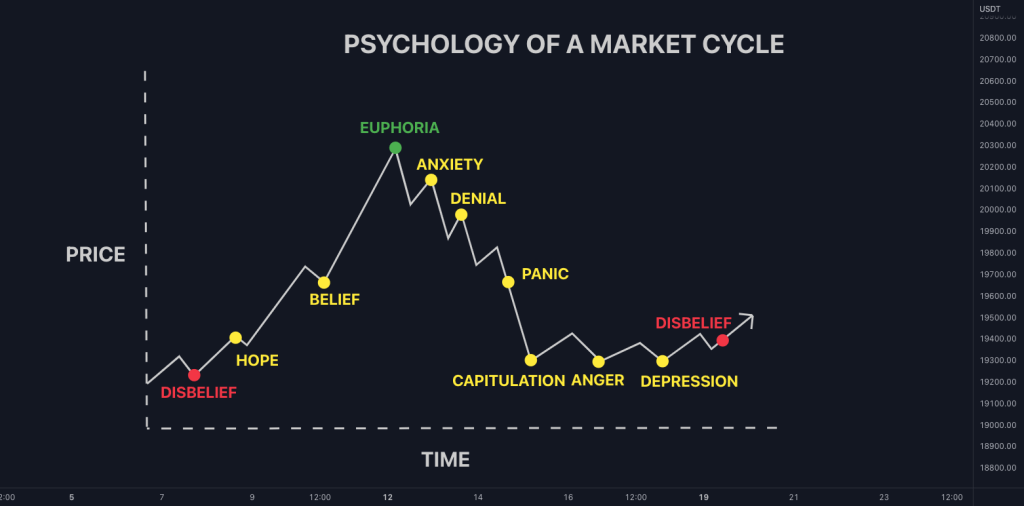
Stock market cycles have typically anticipated economic cycles by 6–12 months on average.
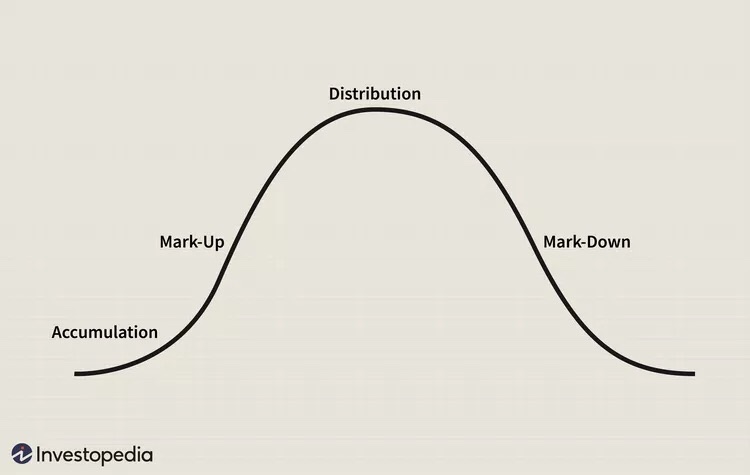
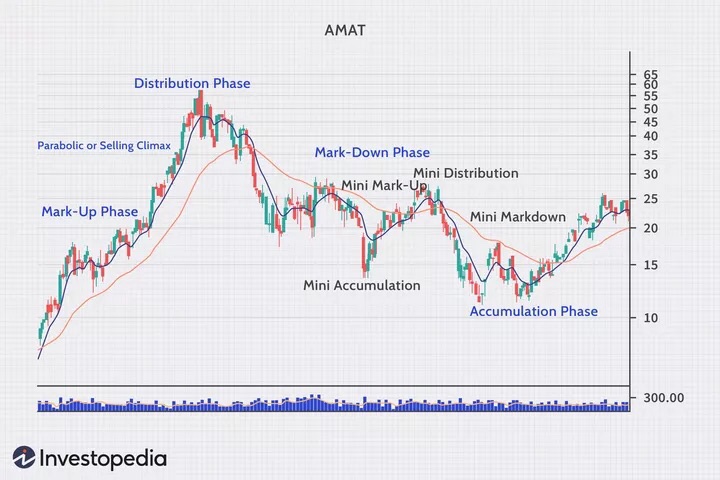
There are four phases of market cycles: the accumulation phase, mark-up phase, distribution phase, and downturn phase
Inflating away debt : When inflation is high, money becomes less valuable – a £50 note buys less today than it did a year ago. The effect of inflation on debt means that governments are, in theory, able to pay off debts using money that’s worth less than when they originally borrowed it.
Keywords : supply chain cycle , cycle time performance , inflating away debt
Sanction
an action taken to enforce a law or rule. Sanctions impose restrictions on certain activities.
Sanctions refer to a variety of measures imposed by one country or a group of countries against another country, organization, or individual to encourage a change in behaviour, punish non-compliance with international norms or laws, or achieve specific policy objectives.
Sanctions can be unilateral, imposed by a single country, or multilateral, involving a collective decision by multiple nations or international organizations. The specific impact of sanctions on a sanctioned country can vary depending on factors such as the severity of the sanctions, the targeted sectors or individuals, the country’s level of economic resilience, and its ability to seek alternative partners or resources. The overall aim is to exert pressure on the government or ruling regime, with the hope of bringing about desired changes in behaviour, policy, or leadership.
Failing to comply with sanctions laws can open up your business to significant legal, financial and reputational ramifications.
If you’re doing business internationally, one thing your company doesn’t need is costly sanctions violations. To help protect your organisation from conducting business with sanctioned entities, it’s essential to have a robust sanctions compliance program, including national and international screening and monitoring, in place. This involves conducting specialised searches through global, government and regulatory databases to identify entities that are barred from participating in certain activities or industries.
Economic sanctions have been used as a tool of war for centuries. In 17th- and 18th-century Europe, economic sanctions were frequently implemented by countries at war. They included prohibitions on trade, the closure of ports against enemies, and bans on trade in certain commodities.
the success of sanctions depends on their enforcement and effectiveness. Sanction efforts are most effective when coordinated and implemented multilaterally with allies, and poor design and implementation of sanctions policies often leads to them falling short of the desired effects.
But a prominent one might be the end of South Africa’s Apartheid regime, where sanctions had an important role in achieving success.
Order is the arrangement or disposition of people or things in relation to each other according to a particular sequence, pattern, or method.
Order is a state in which all components or elements are arranged logically, comprehensibly, or naturally.
the arrangement or disposition of people or things in relation to each other according to a particular sequence, pattern, or method.
Order has many meanings. You can put a line of people in order from tallest to shortest, or from youngest to oldest.
The need for order is a natural human tendency. It enables one to recognise a pattern, a cause & effect, & a sequence. It provides security & allows children to make predictions & assumptions based on experience & strengthens their development of reasoning
Velocity is the speed of something in a given direction
Velocity is the speed in combination with the direction of motion of an object. Velocity is a fundamental concept in kinematics, the branch of classical mechanics that describes the motion of bodies.
Average Velocity
How fast an object is moving is given by the rate at which the position changes with time.
For each position xi, we assign a particular time ti. If the details of the motion at each instant are not important, the rate is usually expressed as the average velocity
.This vector quantity is simply the total displacement between two points divided by the time taken to travel between them. The time taken to travel between two points is called the elapsed time.
It is important to note that the average velocity is a vector and can be negative, depending on positions x1 and x2.
Time is the continued sequence of existence and events that occurs in an apparently irreversible succession from the past, through the present, into the future.
the measured or measurable period during which an action, process, or condition exists or continues : duration. b. : a nonspatial continuum that is measured in terms of events which succeed one another from past through present to future.
In physics, time is defined as the measure of a change in a physical quantity or a magnitude used to quantify the duration of events. Physics is a branch of science that studies time, an important fundamental quantity that is a component of calculating and understanding other areas, such as speed, motion, and velocity.
While it is often referred to as an illusion, it seems as though it is not a nonexistent or false reality, but rather a human-made construct that helps us make sense of our experiences.
According to theoretical physicist Carlo Rovelli, time is an illusion: our naive perception of its flow doesn’t correspond to physical reality. Indeed, as Rovelli argues in The Order of Time, much more is illusory, including Isaac Newton’s picture of a universally ticking clock
Positions
Position (x) can be defined as the location of an object at any given time. The random set of dimensions wherein the position and motions of an item are represented is referred to as a frame of reference. Displacement is the change in the position of an object.
Position and Displacement. Position is the location of the object (whether it’s a person, a ball, or a particle) at a given moment in time. Displacement is the difference in the object’s position from one time to another. Distance is the total amount the object has traveled in a certain period of time.
To describe the motion of an object, you must first be able to describe its position (x): where it is at any particular time. More precisely, we need to specify its position relative to a convenient frame of reference. A frame of reference is an arbitrary set of axes from which the position and motion of an object are described. Earth is often used as a frame of reference
To describe the motion of an object, you must first be able to describe its position (x): where it is at any particular time. More precisely, we need to specify its position relative to a convenient frame of reference. A frame of reference is an arbitrary set of axes from which the position and motion of an object are described. Earth is often used as a frame of reference
Also, an analysis of motion can have many displacements embedded in it. If right is positive and an object moves 2 m to the right, then 4 m to the left, the individual displacements are 2 m and −4 m, respectively.
Motion refers to the change in position of an object with respect to its surroundings over time. Understanding the basics of motion involves concepts such as distance, displacement, speed, velocity, and acceleration. Here are the key elements of motion:
Understanding these concepts helps in analyzing and describing the motion of objects, predicting their behavior, and studying the causes of motion, such as forces and energy.
Most common words
Yes : absolutely , totally , most certainly, certainly, surely , sure , for sure , affirmative , very well , indeed , i believe so , rightfully so , you got that right ,
No : absolutely not , certainly not , not at all , negative , I am afraid not , I can’t say I have , I don’t believe so
I know : I am aware , I am well aware ,
I don’t know : I have no clue , I am clueless , no clue , I don’t have the faintest idea , I am unsure
With : along with , alongside , including , as well as , accompanied by , in tandem with , combined with , coupled with
Maybe : perhaps , Possibly , probably , there is a chance that ,
Okay : excellent, fantastic, wonderful , terrific , alright , very well
Alright : very well ,
Very : extremely , truly , greatly , highly ,
Because : due to , considering , as a result ,
But : however , although , on the other hand , in contrast , nonetheless , nevertheless,
I Like : I am fond of , I am really big on , I fancy , I adore , I relish , I am really into , I am a fan of it , I am passionate about , I have a passion for , I have a weakness for , I have a preference for , I take pleasure in , i enjoy greatly,
i think : I believe , I am confident that , I presume , I assume , personally , in my view , the way I see it ,
A lot : considerable amount of , tremendous amount of , a bunch , a pile , several , countless , plentiful , a great quantity of , loads of ,
So : therefore , thus , hence , consequently , that being said , that is to say
And : on top of that , additionally , as well as, in addition
Thank you : many thanks , I appreciate it , thanks a million , that’s so nice of you , that’s so kind of you
About : with regards to , regarding , concerning , pertaining
I understand : got it , gotcha , I caught that , Gathered that , understood
I don’t understand : I do not follow , I cannot warp my mind around it
Too / also : as well , in addition to this , plus , likewise , supplementarily ,
———————————————————-
Yes : affirmative , absolutely, totally, i agree ,
No : i am afraid not , absolutely not , can’t say i have
I know : i am well aware ,
I don’t know : i am unsure , i do not have the faintest idea , i have no clue ,
With : alongside , in tandem with , accompanied by ,
Maybe : perhaps,
Okay : very well , got it
Alright , very well
Very : extremely, highly , greatly
Because : due to , as a result ,
But : however, although , on the other hand
I like : i relish , i am big on , i h
I think : i believe, i presume
A lot : a great quantity of , a pile
So : thus , hence
And : additionally, on top of that ,
Thank you : thanks a million , thanks very much
About : concerning, pertaining, regarding
I understand : got it , gotcha , i totally get get it
I don’t understand : I do not catch your drift , i am unaware ,
Too / also : alongside, in tandem with , accompanied by
———————————————————-
Common words 2
A lot : tremendous amount
I agree : my thoughts exactly ! You got that right
I do not agree
I partially agree
I am sorry : my apologies ,
Really ? : are you kidding ? , you are kidding , you are not serious , good heavens , psssht , oh come on , you have got to be kidding , get out , come-on , get outta here .
Like : in terms of , such as
Most common questions
How are you ? / How are you doing : How is it going ? How do you do ?
Where are you going ? : where are you off to ? Where are you headed ?
What are you doing ? : what are you up to ?
What did you do ? :
Who is this ? / who are you ? :
What do you want ? :
What do you need ? : need anything ?
Do you know ? :
Where is ? :
What is ? :
Right ? : wouldn’t you say ? Is that it ?
What do you mean : meaning what ?
Common reaction
That’s very impressive , that’s remarkable , unbelievable , you done hell of a job ,
Unreal ,
Oh my goodness , god help me !
How ironic
Common nouns
Thing :
Common adjectives
Common Verbs
Starters
How about this ! ? , here is the thing ! , hear me out , I’ll say this , well ,
Words you should use , in a phrase
Mindlessly :
On average :
Truthfully :
Repeatedly
Recollection : your recollection of what happened is
Random words
Incubate , incubator , primarily , somehow ,
Random group of words
Running a business , work exclusively for , turbulent times , your actions led to , large percentage, maintain a united front , sense of responsibility , disastrous idea , co-creator , a man of your talent , following your father’s footsteps , desperate attempt ,
Random phrases
I didn’t think it would be an issue because primarily it was not concerning their ethic group .
Yes , I acknowledge that I should have spent more time on that .
That’s what I am attempting to say .
I resent the idea that I am insanely hard on my employees .
In the context of a debate , I do no think it was admissible.
To me , that was an incredible opportunity.
Did anyone express displeasure about that decision ?
Do you take accountability for him loosing his job ?
I do not believe it was as deceitful as it appeared to be .
What is the chain of events from there ?
It was a package deal so I had to let the car go with the house .
You let it happen : you allowed it to happen .
I believed in the idea : i have a lot of faith in the idea
People that are on board : People that are down for it
You know the business very well : you know the business in and out
My strong suit
Words to replace
Very : extremely , greatly , highly ,
Change (v) : convert, modify , vary, shift
But : however, although
Because : considering , due to ,
I think : personally , in my view , I assume
Choice : Alternative
Better : more suitable ,preferred ,
Say : mention
Maybe : perhaps, possibly , probably
Always : constantly
Last : final , only remaining
In other words : for lack of a better word
Answer : response( n) / respond (verb)
It does not work that way : it does not operate that way
I do not follow : i do not understand
Pro bono : with out charge
Perfect : beyond reproach
I’ve found : I’ve came across
I was Forced : I was obligated
On the verge :
No : I can’t say I have
anyways : Regardless
Nasty : awful
Every time : whenever , consistently, always
Interesting : fascinating, intriguing, enticing
Usually: more than often
Yes : very well , indeed , sure
Lowkey : Discrete
Literally: word for word , precisely, stricly
Learn : take away
Merely : simply , just
Generic :
Fairly common : happens often
Although : nevertheless
Absolutely: assuredly uh-shoor-id-lee
Curse
Bitch : burps
fuck : yool
niggaz : brothers
fuckery : yoolery
You feel me
ass :
pussy :
done : finished
Fix it : sort it ,
That : which ,
Maybe : perhaps , quite possibly
Pile up : accumulate , aggregate , stockpile , gather , build up , round up , rack up , compile , assemble, add up
Really : truly , in fact , actually , honestly
Wow : impressive , awesome , hooray , gee , my gosh , holy cow , gosh , oh dear , captivating , fascinating ,
Like : in terms of , such as
okay : very well , alright , noted , sure
I don’t know : I am unsure
Stay safe : be cautious , be vigilant,
Do you know ? :
I know :
getting it , you going to see
Only : solely ,
I think so : i believe so
What this means: what this entails/signify / implies / symbolies / implies
Necessitate : entails
Better : more suitable , preferred , more educated
Almost : nearly , close to
soon : shortly , in a bit , momentarily , any moment now , in a moment , quite soon , in next to no time , in no time , in a short while , any minute now , in less than no time , in no time at all , before you know it , in an instant ,
But : however , although , despite that , in spite of that , nonetheless , nevertheless, on the other hand , in the same time , in contrast , on the contrary , by contrast , expecting , let’s assume , presuming , granting that , assuming that , to counterbalance , on the assumption that , still ,
in : inside , within , indoors , during , amidst , into , in the interior of , within the confines of , during the course of , for the durarion of , among , positioned , situated , stationed , allocated , based , established , located ,
so : therefore , thus , hence , consequently
Also : as well
and : as well as, in addition , on top of that
right : most certainly
because : considering , due to the fact , given that , now that , considering that , after all , reason being , seeing that , given , with regard to , taking into account , all things considered , at the end of the day
i think : personally, in my view , I believe , I assume , I suspect
probably : possibly ,
more : extra , also , increasingly, progressively
Talking : conversing
less : barely , to a smaller extent
see it coming : likely , anticipate , foresee , forecast , envisage , imagine
a lot : a bunch , a pile , several , countless , loads of , plentiful , considerable amount of , a great quantity of .
kill : neutralize , disable , eliminate , delete , terminate , destroy , cancel , remove , cross out , wipe out , suppress , overpower ,
alright : acceptable, fair enough , admissible, allowable, valid , without doubt , sound , tolerable
I get it : I see , I caught that , Gathered that , I do understand
I like that : I dig that , exactly right , good thinking ,
the thing : I will say this , the matter at hand , point in question , the concern , the aspect , quality, element , trait , the bone in contention , sore point , the tender spot , point of issue , topic , subject of matter , dispute , apple of discord
With : along with , alongside , including , as well as , accompanied by , in tandem with , combined with
You meant : you intended , you meant to say ,
I tought : I imagine , the way I see it , I reckon , I assumed , I figured , I presume , I reckon , I believed
funny : hilarious , amusing , comical , ironic
thats true : most certainly, sure , right , absolutely ,
ask : demand , inquire , request , require , urge , consult , order , solicit , command , encourage , beg , implore
I wanna go : would want to go , have no choice but to go , better go , have got to go , feel like going , inclined towards going , dying to go
I promise you : I guarantee you ,I could swear , i give you my word , hand to god , have my word ,
Which ended up : which resulted
By all means : absolutely , sure thing , example : Can I come and have a look at your house? Yes, by all means.
Ready : prepared , disposed , prepped , in the mood , decided , all set , up for it , geared up , fit , in place , in order , good to go ,
Mostly : for the most part ,
I just think it’s that : that’s about it
Change : shift ,
I totally agree with you : Absolutely! You’re absolutely right.
Pretty obvious : blatant
It happens often : it is fairly common
Chill : calm
Compensate : refund , repay
never seen that before : unprecedented
just that : strictly that
Almost : nearly , just about , practically , as good as , pretty much , more or less
Choose : select
Have a WordPress.com account? Log in now.

