Framing

It Is vital to framing your artwork, It does not only enhance the final look of the painting, but they also protect it. More often than not, a frame can even add to the monetary value of the painting. Essentially an integral part of the work of art it accommodates, a frame is as important as the art itself.

How important is a frame?

A frame can truly change the feeling of a work of art, drawing the viewer into the art, or distracting the viewer from it

selling artwork framed may result in higher profits

framing is the underdog of the visual design world

Why does framing impact us?

The framing effect occurs when people react differently to something depending on whether it is presented as positive or negative

In the United States criminal law, a frame-up (frameup) or setup is the act of falsely implicating (framing) someone in a crime by providing fabricated evidence or testimony. In British usage, to frame, or stitch up, is to maliciously or dishonestly incriminate someone or set them up, in the sense trap or ensnare.

Framing effect proposes that individuals make decisions based on how an issue is presented, or “framed,” rather than on the facts presented

the framing effect

people may spend more to insure themselves against rare events but leave themselves uninsured against more common events.

Framing, as a theory of mass communication, refers to how the media packages and presents information to the public

A positive frame would accentuate the benefits of choosing a high performing provider or plan. A negative frame would emphasize the risks of choosing a relatively poor performer.

Framing is the skill of using language, tone, and perspective to shape how others perceive and interpret your message

starting to sell picture frames online has become a profitable business opportunity.

Vocabulary

Expressions

Yes : a thousand times yes, your wish is my command , it would be my pleasure, my thoughts exactly , certainly consider it done, sounds good , yes sure here you go , no problem! Always happy to help, yes I would be happy to,

No : in a word! no , not likely , not a chance, negative, count me out, I’d rather not if you don’t mind, I’d love to but, maybe another time, sounds great! But I can’t commit, I’ve got too much on my plate right now, no thanks! I have another commitment, I am at the end of my rope right now so I have to take a rain check, thanks for thinking of me but I can’t, not this time, sadly I have something else, I am going to have to exercise my no muscle on this one, perhaps next season when things clear up, my body says yes but my hear says no, that doesn’t work for me, sounds good but I am not available, we appreciate the offer but,

I know : I’ve figured it out, I have a plan, I’ve worked it out, point taken,

I don’t know :

With :

Maybe: fifty fifty chance, I’m undecided, I’m in the “who knows” camp, it’s a maybe kind of day, I’m on the fence about it, I’m in a “wait and see” mode, might be might not be, it’s still a question mark, I’m in a a we’ll see mood, it’s a toss-up in my book,The thought have crossed my mind

Okay :

Alright :

Very :

Because :

But :

I Like :

i think :

A lot :

So :

And :

Thank you :

About :

I understand :

I don’t understand :

Too / also :

———————————————————

Rare : That’s a rare occurrence

Always : on every occasion, whatever the circumstances

Every time : whenever, on every single occasion,

Big : large, massive, gigantic, enormous

Small:

Tall :

Short :

Easy :

Difficult :

Happy : in good spirits

Sad : unhappy, earthbroken, miserable

Worried :anxious,uneasy,nervous, on edge

Discouraged :

Why : to what end, why on earth,

When: at what point/time, how early/late

Who

Where

How

How much

If :

Forever

Sometimes :

One time : on one occasion, once!

General : overall, widespread,universal

Everywhere : all around

Nowhere :

Anywhere: anywhere near,

Anyways : besides

A little bit more : slightly more

Whatever : regardless

Whoever:

Too much

Too little

At all : not remotly, whatsoever, in any way

A lot :

To express surprise: unbelievable, you’re kidding, oh come on, good heavens, get out, you have got to be kidding me, for God’s sake, for goodness sake, for the love of God, you cannot be serious, for the life of me, strike me pink,

To express something obvious and unnecessary: there’s the surprise of the century, thank you captain obvious, well knock me down a feather

Used to :

Every time : whenever

Let it happen : let it play out , unfold

Literally :

It feels :

Basic :

That’s true :

Since you said that : since you brought it up, now that you mentioned that

Go for : opt for, select , settle on , working/pushing/going towards, aim, pursue, directing,

Check everything : leave no stone unturned, thorough search,

No doubt at all : without a shadow of a doubt

When I was :

What I’m trying to say here: essentially what I intend to say/express ,

Could do : potentially might do

No it’s not like that : Quite the opposite in fact ,

I did not hear you : I didn’t catch that ,

That’s so funny : I find this so amusing ,

You can do it too : you can crack the code

That’s better :that’s more like it ,

That’s what you should do : it’s the right call

Don’t go hard on him (as an interrogator): feed him soft balls

He is very hard/ dangerous : he’s a menace

Leave me in the wind

Understand why : Put my finger on it

I thought about it : The thought have crossed my mind

That’s rare / sometimes :That’s a rare occurrence

Keep trying / never give up : Fall down 3 times stand up 4

The best thing you can do : Your best bet, most reliable option

Push towards : encourage

The funny thing is : ironically, it’s ironic how,

Represents a lot : iconic

Means a lot : symbolic

The most important thing : more importantly

well-designed

Getting more serious : intensifying

What’s going to happen : how it will unfold

I’m chocked : I find it chocking / I find that chocking

Come again/ I didn’t hear you: I didn’t catch that

So many: countless, loads of, tons of

Not enough: limited, insufficient, unacceptable, mediocre, unsatisfactory, disappointing, unsuitable,

:Undermine

But you know : well thing is

It’s funny : it’s ironic

Me : as for me

The Thing about it : thing is

What you just said : what you mentioned

In the last few days/months :Lately

Exactly: precisely

It’s very big : it’s hugely popular

This Business is still good and getting bigger : this business is still thriving

The problem is : Trouble is !

Thats the thing we think is gonna happen : that’s the expectation

It’s hard to answer this : We struggle to answer this

Things you want to get done: things you want to achieve

Good example : prime example

Biggest problem : biggest obstacle

Make money and grow : prospering

Benefits / good things : upsides

Bad things : downsides

No matter what : (Rain, thunder or lightning) , this year we are going to election number 31.

What do you think of this : what’s your biggest takeaway from this ?

What really matter : the significant points

Sometimes : rarely, occasionally!

Come again : I didn’t catch that

I see what you saying:

Way easier : far easier

A lot of accounts : a wide range of accounts

:Speculating

Reveal : disclose

Amazing : spectacular

Not to turn this into a boston promo

The biggest new company : Hottest startup

The thing was very bad for the economy : The  move was hugely disruptive for the economy

It got big very fast : it grew at an explosive rate

A lot of protests started happening in the country: protests have erupted across the country

Its crazy and dangerous down there: its a no mans land

I am not going to be too long : well , I won’t hold / keep you any longer

I’m not gonna make it sound bigger than it is :

Thats something we not gonna forget: that’s one for the books

Here! Take this : there you go / here you go

You did a good job there : your work in all this has been incredible

It’s been almost a year since : It’s been nearly a year since

has hit a wall.

Make it become better : enhance

Pretty big amount : sizable amount , fairly large amount

With pleasure : Gladly

There is always a problem : it’s always something

I’m not saying that : Far from saying that

What I was saying is : What I intended to say is

It seems like : possibly! Apparently ! , it sounds like, it sounds as if you are, give the idea of, echo, it occurs to one as, it gives the idea of being, it shows every sign of being, give every expression of being

It’s not easy : it’s far from being easy

In essence:

What did you learn about this… : what are some takeaways from this ?

Around the same area : similar location

Pretty big difference : noticeable difference

Added way more : hugely increased

He surpassed : he overtook

I just did : I recently did

Brand new information: recent reports

This paper Tells you everywhere the car went : this paper details the movement of the car

It was good for him : he benefited from this

Know a lil bit about / is not used to : is not remotely familiar

Intensify : ratchet up

Quite : fairly

Putting a lot of time in/ working hard:really invested in

Here ! : here you go!

Really crazy: borderline insane

Common : every day average , regular

Before : previously , prior

Heard of : be aware , make aware , become aware , know about , discover

I like : I like the sound of that ,

Coming soon : will be there soon , in a day or two , in a minute or two , approaching , nearing , impending, incoming , looming , pending , imminent , in a short time , just around the corner , upcoming , coming up , forthcoming, happening soon , in the pipeline , be here shortly ,

Try : attempt , make an effort , seek , shoot for , endeavor , do your best , tackle ,

I can’t see it from here : it is not visible from here.

The land looks empty : the land looks deserted

I am fine : I am fantastic

Do you want to go back : do you want to head back ?

Good : that sounds great

I don’t have anywhere to go : I do not have any particular place to go

Wait : hang on

I do not know what to say : I am speechless / I am out of words

Acting or being really drunk or drugged out : I am out of it

White eyes : milky eyes

I was looking for you and stumbled on you by accident : I am so glad I ran into you !

Do not take it the wrong way : Don’t misinterpret what happened

stuff like that : things of that sort, things of that nature

Good job : nice work

Alright, let’s go : alright, it’s showtime! , alright let’s rock and roll !

Most common :

At some point :

The Prince was there, that’s crazy! : the prince was there, How bout that!?

:Overcoming adversity

I’m sure: I’m convinced

A real chance : a real shot

A real opportunity: a Genuine opportunity

A few days / months ago : recently

Yes, that’s what we should do : well That’s the idea —> You telling me we have to walk all the way back home. – well, That’s the idea !

That’s smart ! : that’s clever !

It’s your decision : it’s your call

Hard decision : tough call

I can’t take another one : I can’t stomach another one

Take in / wrap my mind around: Digest

Barely: hardly

Please,Help me! : please,give me a hand!

We need to redo the whole thing! : Back to the drawing board !

It’s always like that : that’s always the case

In the same way ! : by the same token!

We have to do it fast : time is of the essence

What always happen is : a very common occurrence is

The problem is : the problem it represents is

Back when this was popping ! : back in it’s heyday!

Anyways : either way

It’s not my problem: it’s not my concern

Everything happened perfectly :everything went like clockwork

That’s nice : that’s kind of you

The idea : tought, notion, perception

The problem : issue, trouble, mess, obstacle, pickle, headache, tight spot

The formation : shaping, composition, design, structure, make up

The importance :

He’s gonna blow up / he’s gonna get big : he’s going places!
I’m down : Count me in
The problems that comes with that : the challenges associated with that
Kept saying : has repeatedly said
They don’t serve to nothing: they are fruitless
Also ! : likewise !
A big thing : a significant change
He refused to say anything : he declined to comment
Considering : taking into account
He is saying he is for : Voiced support for
He is saying no to : voicing his opposition to
Said he’s worried : he voiced concern over
Said why / said how/ told why/ explain: expressed
He got bashed by : he got Slammed by
Is getting criticized for : is drawing criticism for
If it’s true : how credible is
Is gonna try to : is aiming to , attempting to
He’s doing good : He’s doing well
Way(more,less): significantly/ Far (more,less)
Needs : necessitates
: Draw attention
Canceled / stopped the event: suspended
He’s really big,known : he’s enormously popular, he’s hugely popular
It didn’t work : it fell through
I have said something about this/ I talked about this: I’ve commented on this
Worries me a little bit: concerns me a little bit
It saying that if : It Argues that
I can even say that : I can argue that
Right in the middle of : right at the heart of
In the last years/months: Lately,recently
Let’s talk about something else: let’s move on
I’m kind of shocked: It’s a little surprising that,
I think I am done with : I’m officially done with
When you are here : your presence
Afterward : subsequently
Okay that’s perfect : sounds good to me!
Makes the problem bigger : it contributes to the problem
Small problems : minor problems
Didn’t do a lot / barely did anything : have minor accomplishments
Not that easy : not necessarily easy
Got back : returned


Expression 3
I still believe : I remain confident
:Worth a lot
: I Wonder why
What are you trying to do? : what is it you trying to achieve ? / aiming to achieve
They are becoming more into his vibe : They are Becoming more aligned with his brand
:Sparring with people
Making people more and more angry : Fanning the flames of Discontent
His tweets are wild : his tweets are incredibly irresponsible
When he became popular : when he first came to prominence
People liked it : people received him well
People will not accept this : people will not tolerate this
Looking for protection : seeking protection
Looking for somewhere to hide : seeking refuge
He makes people want to fight: he encourages violence
Money is going down : currency devaluation
Prices are going up : soaring inflation
The price of bread and oil went up fast : the price of commodities such as food and transportation skyrocketed
I have a lot of things to do : I have a lot on my plate

: Introduce a point
Explain the problem to me : give me a concise description of the facts that need to be addressed
He already said he wanted to : he already stated his intention to
Can you tell me your favorite songs: Can you list your favorite songs
You got to accept how serious the problem is : you must recognize the seriousness of the problem
To show you I’m right, I will about : To illustrate my point, I will tell you a story you
Can I tell other people what you just said : Can I quote you on that ?
He said the show was a big deal : he hailed the performance as, quote, an extraordinary achievement
I can’t tell you the exact numbers but you can see them online : I can’t quote the exact statistics for you offhand, but you can find them online
He’s always saying a verse from the bible : he quotes the bible frequently
I’m quoting you : I am saying what you said
He really thought about what the things she said happened : he examine the evidence carefully
Can you tell me why you doing this : Can you enumerate your reasons for doing this
Imma tell you what’s wrong with this idea : Let me enumerate many flaws in your hypothesis.
There is too many mistakes : The errors are too many to enumerate.

It’s funny how: it’s ironic how

D

Doing better : flourish


Adjectives / descriptive words

Beauty : attractive, gorgeous, lovely, magnificent,

awful, monstrous,horrible, aHideous, grotesque, unpleasing, unattractive,

Size : gigantic, colossal, immense, boundless, giant, curvy, grand, hefty, life-size, immeasurable, limitless, vast, wide

Mini, minuscule, miniature, narrow, pocket-size, oversize, overweight,

Towering

Slim,

Style

Smell

Distance

Battle/war : strategic , symbolic , send a clear message,

Disaster/catastrophe: the impact was devastating, whole town reduced to ashes,

Business : business prospects appear bleak, hugely popular

Economics

Politics

Disaster

Adverbs

Ironically, undoubtedly,

Verbs

Fuel, feed, supply, incite,inflame, sustain

Enhance , increase, improve, add to, intensify, magnify, amplify, inflate, strengthen, build up, supplement, augment, boost, upgrade, raise, lift, escalate, elevate, exalt, enrich, complement, heighten, deepen, stress, reinforce, underline, emphasize,

Opposites

Apply – misapply ,

———————————————————

We will tell you whats different and what’s the same

The result we got and the conclusion we made

Ww will give you example and explain it

We will tell you the most important thing and one particular thing you should know !

We will emphasize on a good part and focus and link sone other parts!

We will tell you the time and the sequence in which it happened

Anyways, let’s correct the mistakes we made

Contrast/ different : However, but, nonetheless, in comparison, by comparison, on the other hand

Similarity/same : similarly, likewise,

A2 B F H I6 P S

According to , as far as , based on, in my ,is, it, it’s , I’ll, I’m convinced, To put it, speaking

According to my understanding , to my estimation , to my way of thinking

As far as I’m concerned, I understand

Based on my estimations, my observation,

In my view, my point view,

Thing is, point is , bottom line is that,

It’s clear to me,

I’m convinced, I believe, there is no doubt that ,

To put it bluntly, clearly

Honestly speaking

——————————————————

Foot on my neck

Way to go

Hit the spot

Not the way you want to go

Out of curiosity

That goes to show

She hit the nail on the head

Try it / go for it : Take your shot

Last but not least

Out of pocket

Simply put

The goal post

That’s life : This is the way life goes

Things of that nature .

All your docks in a roll

Wee bit of joy

Put things into perspective

Starting now : From this point foward

For lack of a better word

It burns brighter : has a bigger impact

Exercise my options

Rub me the wrong way

Go Big : Aim for the best

Fish out of water

Foot of the gas

Fill in the gaps

Peel the layer back a bit

We shouldn’t have to pull teeth

What Led to that

Imma let you talk :Give the floor to you

Break a leg

That’s the past/ I moved on : It’s water under the bridge

A nail in the coffin

Can i take a rain check

Carry own

Time is fire we all burn

I just want to throw that in there

You guys made fantastic points

You throw some lipstick on that thing you can have a prom queen

Tooth and nail

Do not fash – do not worry

Dont bring bricks in a glass house

Let’s wrap this bad boy up

Mean what you say , say what you mean

What’s not to love

Right up you alley – good at doing

Save it in my mind : Make a mental note

On interesting note

Open and shut case

That name sounds good ! : It’s got a ring to it

Not to say the least

She is certainly a diamond

Im an open book I have nothing to hide

Hes got some fire in his belly

Words / phrases to use

Which is nice , very impressive,

congrats : congratulations are in order

it’s nothing that can’t be fixed , honest to god , rest assured , tell you what ,

That’s good : that sounds great

, there you are , (the movies/anything or place ) it is , what do you know ?! ,

Wait a sec : hang on

how about that ! ,

, I am so glad I ran into you ! , clunky , not my finest hour ,

, ingenious , very much so , he/she looks so good hard to believe hes not a model , unexpected / dramatic turn of events ,

people terrify me : People are crazy

you don’t say : no way , sure thing ,

continue/proceed : go on

got it ! : I heard you and understood ,

Outcome of a situation is unpredictable : I don’t know all bets are off

—————————————————-

Curse

Bitch : burps

fuck : yool

niggaz : brothers

fuckery : yoolery

You feel me

ass :

pussy :

done : finished

Fix it : sort it ,

That : which ,

Maybe : perhaps , quite possibly

Pile up : accumulate , aggregate , stockpile , gather , build up , round up , rack up , compile , assemble, add up

Really : truly , in fact , actually , honestly

Wow : impressive , awesome , hooray , gee , my gosh , holy cow , gosh , oh dear , captivating , fascinating ,

Like : in terms of , such as

okay : very well , alright , noted , sure

I don’t know : I am unsure

Stay safe : be cautious , be vigilant,

Do you know ? :

I know :

getting it , you going to see

Only : solely ,

I think so : i believe so

What this means: what this entails/signify / implies / symbolies / implies

Necessitate : entails

Better : more suitable , preferred , more educated

Almost : nearly , close to

soon : shortly , in a bit , momentarily , any moment now , in a moment , quite soon , in next to no time , in no time , in a short while , any minute now , in less than no time , in no time at all , before you know it , in an instant ,

But : however , although , despite that , in spite of that , nonetheless , nevertheless, on the other hand , in the same time , in contrast , on the contrary , by contrast , expecting , let’s assume , presuming , granting that , assuming that , to counterbalance , on the assumption that , still ,

in : inside , within , indoors , during , amidst , into , in the interior of , within the confines of , during the course of , for the durarion of , among , positioned , situated , stationed , allocated , based , established , located ,

so : therefore , thus , hence , consequently

Also : as well

and : as well as, in addition , on top of that

right : most certainly

because : considering , due to the fact , given that , now that , considering that , after all , reason being , seeing that , given , with regard to , taking into account , all things considered , at the end of the day

i think : personally, in my view , I believe , I assume , I suspect

probably : possibly ,

more : extra , also , increasingly, progressively

Talking : conversing

less : barely , to a smaller extent

see it coming : likely , anticipate , foresee , forecast , envisage , imagine

a lot : a bunch , a pile , several , countless , loads of , plentiful , considerable amount of , a great quantity of .

kill : neutralize , disable , eliminate , delete , terminate , destroy , cancel , remove , cross out , wipe out , suppress , overpower ,

alright : acceptable, fair enough , admissible, allowable, valid , without doubt , sound , tolerable

I get it : I see , I caught that , Gathered that , I do understand

I like that : I dig that , exactly right , good thinking ,

the thing : I will say this , the matter at hand , point in question , the concern , the aspect , quality, element , trait , the bone in contention , sore point , the tender spot , point of issue , topic , subject of matter , dispute , apple of discord

With : along with , alongside , including , as well as , accompanied by , in tandem with , combined with

You meant : you intended , you meant to say ,

I tought : I imagine , the way I see it , I reckon , I assumed , I figured , I presume , I reckon , I believed

funny : hilarious , amusing , comical

thats true : most certainly, sure , right , absolutely ,

ask : demand , inquire , request , require , urge , consult , order , solicit , command , encourage , beg , implore

I wanna go : would want to go , have no choice but to go , better go , have got to go , feel like going , inclined towards going , dying to go

I promise you : I guarantee you ,I could swear , i give you my word , hand to god , have my word ,

Which ended up : which resulted

By all means : absolutely , sure thing , example : Can I come and have a look at your house? Yes, by all means.

Ready : prepared , disposed , prepped , in the mood , decided , all set , up for it , geared up , fit , in place , in order , good to go ,

Mostly : for the most part ,

I just think it’s that : that’s about it

Change : shift ,

I totally agree with you : Absolutely! You’re absolutely right.

Pretty obvious : blatant

It happens often : it is fairly common

Chill : calm

Compensate : refund , repay

never seen that before : unprecedented

just that : strictly that

Almost : nearly , just about , practically , as good as , pretty much , more or less

—————————————————-

Vocabulary Mistakes

Toward and towards are completely interchangeable, so you can use either one whenever you want.


Informal to Formal

Ask for –> Request
Book –> Reserve
Check –> Verify

Get –> Receive
Help –> Assist
Need –> Request
Say sorry –> Apologies
Start/ Begin –> Commence
End –> Terminate/ Finish
Try –> Endeavour
Deal with –> Handle
Tell –> Inform ➕
Wait for –> Await
Fight –> Combat
Use/Eat –> Consume
Go –> Depart
Tough –> Difficult
Small –> Diminutive ✖️
Explain –> Disclose
Set out –> Display
Throw out –> Eject
Old –> Elderly
Say –> Express ➕
Afraid –> Fearful
In the end –> Finally
Lucky –> Fortunate

But –> However
Wrong –> Incorrect
Go up –> Increase
Cheap –> Inexpensive
At first –> Initially
Mad –> Insane
Bright/smart –> Intelligent
Big/Large –> Enormous
Right –> Correct
A bit –> A little
Away –> Absent
Speed up –> Accelerate
Okay, ok –> Acceptable
Help –> Aid/ Assist
Let –> Allow
Call off –> Cancel
Friendly –> Amiable

Expect –> Anticipate
Seem –> Appear
Climb –> Ascend
Beat up –> Assault
Fall out –> Quarrel
Eager –> Avid
Stop –> Cease
Dare –> Challenge
Kids –> Children

Settle for –> Choose
Round –> Circular ✖️
Pick up –> Collect
Think of –> Conceive
Link up –> Connect
Think about –> Consider
Build –> Construct
Refer to –> Consult
Hurt –> Damage, harm
Go down –> Decrease
Want/ hope –> Desire
Lack –> Deficiency
Show –> Demonstrate
Brave –> Courageous
Pin down –> Determine
Put/ set down –> Deposit
Throw away –> Discard
Make out –> Discern
Talk about –> Discuss/consider
Give out –> Distribute
Give –> Donate
Remove –> Eliminate
Imagine –> Envisage✖️

Break out –> Erupt
Get out –> Escape
Avoid –> Evade
Go through –> Examine
Make up –> Fabricate
Test –> Experiment
Ease –> Facilitate
Come after –> Follow
Sick –> Ill
Ask out –> Invite
Go away –> Leave/ depart
At once –> Immediately
Free –> Liberate
Deal with –> Manage
Bad –> Negative
Look into –> Investigate
Chance –> Opportunity
See –> Perceive
Happy –> Pleased
Give up –> Quit
Older –> Senior
Use –> Utilize
Enough –> Sufficient

End –> Terminate
Empty –> Vacant
Rich –> Wealthy
Mend –> Repair
Idea –> Notion

Mainly –> Principally
See –> Observe
Leave out –> Omit

Go against –> Oppose
Hungry –> Famished ( fè mécht )
Childish –> Immature
Maybe –> Perhaps
Good –> Positive
Give –> Provide
Buy –> Purchase
Say no –> Reject
Free –> Release
Look for –> Seek
Choose –> Select
Get by –> Survive
So –> Therefore
Put up with –> Tolerate
Block –> Undermine
Catch up –> Understand
Sight –> Vision
Young –> Youthful
Get –> Obtain
Need –> Require
Pay back –> Repay
Live –> Reside
Point out –> Indicate

Find out –> Learn/Discover
Get away –> Elude
Come in –> Enter
Lively –> Energetic
Clear –> Transparent
Whole –> Entire/Complete
Blow up –> Explode
Break down –> Fail/Collapse
Hopeless –> Futile ( fyoo dol )
Hit out at –> Criticise
Tired –> Exhausted/ Fatigued
Clothes –> Garment
Go before –> Precede
Thanks –> Gratitude
Hurry –> Haste, hasten
Funny –> Humorous, amusing
Better –> Improved
Dim –> Indistinct
Worse –> Inferior
Put in –> Insert
Bring in –> Introduce
Make up –> Invent
Kidding –> Jesting

Naked –> Nude
Childish –> Infantile
A lot of –> Numerous
Stubborn –> Obstinate ✖️
Danger –> Peril✖️
Put off –> Postpone
Here –> Present
Keep –> Preserve
Go ahead –> Proceed
Go after –> Pursue
Anyways –> Nevertheless
Let –> Permit
Sweat –> Perspiration✖️
Look at –> Regard
Laid back –> Relaxed
Take out –> Remove
Rack up –> Accumulate
Over –> At an end

king –> Attractive
Good for –> Beneficial
By –> By means of
Lead to –> Cause
Complex –> Convoluted✖️
Go out of –> Exit
Death –> Demise
Break off –> Suspend/adjourn✖️
Also –> In addition, additionally

Wood –> Timber
Describe –> Depict ( the pikt )
Go on –> Continue
In charge of –> Responsible
Enjoyment –> Gratification
Dirty/ polluted –> Contaminated
Again & again –> Repeatedly ✖️
Marvelous –> Exceptional
Really big –> Considerable
Can –> Is capable of
Fork out –> Pay (money)
Talk into –> Persuade
Come up to –> Reach/attain
Iron out –> Solve/overcome
Next/later –> Subsequently
Try out –> Test
Call on –> Visit
Drop out of –> Withdraw (from)
Look up to –> Respect
Look like –> Resemble➕
Job –> Occupation➕
Dad –> Father
Boss –> Employer➕

Avoid –> Evade
Also In –> Addition,
Ask –> Enquire
Afraid –> Fearful
At First –> Initially➕
Ask For –> Request➕
Again & Again –> Repeatedly➕
ABit –> ALittle
Avoid –> Evade
Anyway –> Nevertheless
Ask Out –> Invite
Away –> Absent➕
At Once –> Immediately➕
A Lot Of –> Numerous

Bright/smart –> Intelligent
Buy –> Purchase
Build –> Construct
But –> However,
Bad –> Negative
Beat up –> Assault
Break out –> Erupt
Block –> Undermine
Blow up –> Explode
Boss –> Employer
Brave –> Courageous
Better –> Improved➕
Big/Large –> Enormous➕
Bring in –> Introduce
Break off –> Suspend/adjourn
Break down –> Fail/Collapse
Check –> Verify➕
Come after –> Follow
Choose –> Select➕
Clear –> Transparent➕
Come in –> Enter➕
Call off –> Cancel
Complex –> Convoluted
Call on –> Visit
Childish –> Infantile
Chance –> Opportunity ➕
Cheap –> Inexpensive➕
Can –> capable of➕
Come up –> to Reach/attain
Climb –> Ascend
Clothes –> Garment
Dirty/ polluted –> Contaminated
Danger –> Peril➕
Dare –> Challenge➕
Dad –> Father
Describe –> Depict ➕
Deal with –> Handle
Dim –> Indistinct
Death –> Demise➕
Deal with –> Manage
Drop out of –> Withdraw (from)
End –> Terminate/ Finish
Ease –> Facilitate
Eager –> Avid
Expect –> Anticipate
Enough –> Sufficient ➕
Explain –> Disclose
End –> Terminate
Empty –> Vacant ➕
Enjoyment –> Gratification

Friendly –> Amiable➕
Free –> Liberate
Fork out –> Pay (money)
Fall out –> Quarrel
Fight –> Combat➕
Get –> Receive➕
Get out –> Escape
Go –> Depart➕
Go before –> Precede➕
Go after –> Pursue
Good looking –> Attractive ➕
Give –> Donate
Go down –> Decrease➕
Go through –> Examine
Good for –> Beneficial➕
Go ahead –> Proceed➕
Go up –> Increase➕
Go on –> Continue➕
Go out of –> Exit
Give up –> Quit➕
Get away –> Elude
Go away –> Leave/ depart
Give out –> Distribute➕
Go against –> Oppose ➕
Get –> Obtain➕
Good –> Positive➕
Get by –> Survive
Hit out at –> Criticise
Hungry –> Famished ( famécht ) ➕
Here –> Present➕
Help –> Assist ➕
Hopeless –> Futile
Happy –> Pleased ➕
Hurry –> Haste, hasten
Hurt –> Damage
Idea –> Notion➕
Imagine –> Envisage
In charge of –> Responsible
Iron out –> Solve/overcome
Job –> Occupation➕

Keep –> Preserve
Kidding –> Jesting
Kids –> Children
Look up to –> Respect
Look at –> Regard
Lucky –> Fortunate
Lead to –> Cause
Let –> Allow
Lucky –> Fortunate
Lack –> Deficiency
Look for –> Seek
Let –> Permit
Live –> Reside
Leave out –> Omit
Look like –> Resemble
Lively –> Energetic
Laid back –> Relaxed
Live –> Reside
Look into –> Investigate
Make up –> Fabricate
Mainly –> Principally
Mad –> Insane
Maybe –> Perhaps
Mend –> Repair
Marvelous –> Exceptional
Need –> Require
Naked –> Nude
Next/later –> Subsequently
Old –> Elderly
Over At an –> end
Okay, ok –> Acceptable
Older –> Senior
Put off –> Postpone
Pay back –> Repay
Put/ set down –> Deposit
Pin down –> Determine
Put in –> Insert
Pick up –> Collect

Put up with –> Tolerate
Point out –> Indicate

Really big –> Considerable
Remove –> Eliminate
Rack up –> Accumulate
Refer to –> Consult
Rich –> Wealthy
Round –> Circular
Right –> Correct
Show –> Demonstrate

Speed up –> Accelerate
Stop –> Cease
Set up –> Establish
Sick –> ill
Stubborn –> Obstinate
Start/ Begin –> Commence
Shorten –> Decrease
Settle for –> Choose
Say no –> Reject
Small –> Diminutive
See –> Observe
So –> Therefore
Sight –> Vision
Seem –> Appear
Set out –> Display
Seem –> Appear
Sweat –> Perspiration
Say sorry –> Apologise
Say –> Express
Talk into –> Persuade
Tired –> Exhausted/ Fatigued
Throw away –> Discard
Take out –> Remove
Test –> Experiment
Thanks –> Gratitude
Tough –> Difficult
Try out –> Test
Talk about –> Discuss/consider
Throw out –> Eject
Think of –> Conceive
Try –> Endeavour
Think about –> Consider
Tell –> Inform
Use –> Utilize
Wood –> Timber
Want/ hope –> Desire
Wrong –> Incorrect
Wait for –> Await
Want –> Desire

Worse –> Inferior
Whole –> Entire/Complete
Young –> Youthful
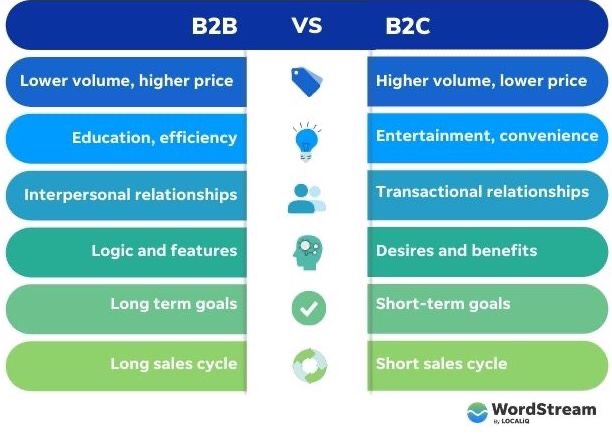
B2b vs b2c

B2B

you don’t need as many customers to make good money, since you can charge higher prices.

Long-term relationships with customers generate consistent and predictable revenue for the business.

B2B customers are more likely to have higher lifetime value than consumers, as well.

B2B more expensive

B2B products and services are often more complex and require specialised expertise, and the target market is businesses, which can afford to pay more

4 types of B2b : producers, resellers, governments, and institutions

Most brands end up posting 11-20 posts per month.

they are buying your product or service for their company.

selling products or services to other companies

B2B has the advantage of high profit margins and retention rates,

disadvantage of a long sales cycle and fewer customers

A long sales cycle is one of the most common challenges in B2B sales.

Manufacturers & wholesalers often look to gain a 15-20% profit margin on their products. Usually, retailers aim to make a profit between 20-50 %

Is B2B sales a good career?

in California, it is $58,780 As one progresses in their career and grows to the B2B consultant level, the salary has no higher cap.

sales prospecting to be one of the biggest challenges in the B2B sales process

B2B sales come in three different types:

• Type 1: Supply sales.

• Type 2: Wholesale/distribution sales.

• Type 3: Service/Software sales.

• Higher average transaction value.

• Longer sales cycles.

• Multiple stakeholders.

• Educated buyers.

Examples of B2B Sales

• Companies that produce tire casings sell them to car manufacturers.

• Supermarkets order items at wholesale prices to sell at higher prices to individuals.

• Lawyer firms work on corporate cases.

• Marketing studios prepare strategies and provide content for brands.

B2C

you are selling to individuals. Your product would be designed and developed to solve the problems of everyday people.

the market price is fixed for every B2C product. So, your profit will depend a lot on the number of items sold.

a lot of money in the B2C sector, too, but it requires you to first build a massive customer base

DIFFERENCES

B2B sales professionals often earn a higher income than B2C sales professionals

You can make a lot of money in the B2C sector, too, but it requires you to first build a massive customer base. You need a lot of customers to make good money in the B2C sector. There is often more money in B2B, and with B2B, you don’t need as many customers to make good money, since you can charge higher prices.

B2C sales is usually less complex than B2B. This is because B2B salespeople are working with experts in their industries and selling complex products and services. While B2C sales is also complex and can require years to learn, there is less risk in most B2C purchases

B2B ecommerce utilises online platforms to sell products or services to other businesses. B2C e-commerce targets personal consumers

Economics Short

Economics terms short

Absolute Advantage, Absolute Poverty, accelerating inflation, accelerator, active balances, Actual growth in national output, ad valorem tax, Adam smith, aggregate demand, aggregate supply, aid, allocative efficiency, allocative mechanism, alternative demand, anticipated inflation, appreciation, at constant prices, asymmetric information, at current market prices, automatic stabilizers, autonomous investment, autofocus savings, average cost, average fixed cost, average product, average propensity to consume, average propensity to import, average propensity to save, average propensity to tax, average revenue, average tax rate, average variable cost, balance of payments, balance of trade in goods account, balance of trade in services account, balanced budget, balancing items, bank deposits, barrier of entry or exit, bilateral trade, break-even point,

Barter, base year, behavioral economics, birth rate, Brics, Broad money supply, budget deficit, budget line, budget surplus, buffer stock, business (or trade) cycle, canons of taxation, capital, Capital account of the balance of payments, capital investment spending, capital output ratio, capital ratio, capital-intensive production, cartel, cash, central bank, ceteris paribus, change in demand, change in quantity demanded, change in quantity supplied, Cheque, circular flow of income, claimant count, closed economy, closed shop, collective bargaining, common external tariff, comparative advantage, complementary goods, composite demand, concentration ratio, conglomerate integration, constant returns to scale, consumer price index, consumer surplus, consumption, contestable market, contracting out, contraction in demand, contraction in supply, Contractionary fiscal policy, cost efficiency, cost of living, cost benefit-analysis, cost-push inflation, credit, credit creation, credit multiplier, creeping inflation, Cross elasticity of demand (or cross- price elasticity of demand), current spending, Current account of the balance of payments, current transfers, custom union, deadweight loss, death rate, Decreasing returns to scale, deficit, deflation, deflationary gap, demand, demand curve, demand schedule, Demand-pull inflation, demerit good, dependency ratio, Depreciation (of capital), deregulation, Derived demand, devaluation, Diminishing marginal utility, “Direct provision of goods and services”, direct tax, Discretionary fiscal policy,diseconomies of scale, disequilibrium, disequilibrium unemployment, disinflation, dissaving, distribution of income, diversification, division of labor, “Double coincidence of wants”, dumping, dynamic efficiency, Economic growth, economic law, economic problem, economic rent, economic union, Economies of large dimensions, Economies of scale, effective demand, efficiency, “Efficient resource allocation”, elastic, embargo, enterprise, enterprise culture, entrepreneur, equality, equilibrium, equilibrium price, equilibrium quantity, equilibrium unemployment, Equi-marginal principle, equity, exchange controls


Absolute advantage : 

a situation where a country can produce a particular good or service using fewer resources than another country

 Absolute poverty : 

a condition where household income is below the level necessary to maintain basic living standards in relation to food, shelter and housing

 Accelerating inflation : 

a situation where the rate of inflation is rising over a period of time

 Accelerator:  

a way of calculating the effect of a change in national income on investment in an economy

 Active balances : 

money that is flowing through the economy, underpinning the transactions and precautionary motives for holding money

 Actual growth in national output: 

a movement from within the production possibility curve of an economy

to a position on the production possibility curve, resulting from the better utilisation of the existing factors of production

  Ad valorem tax : 

an indirect tax with a percentage rate (e.g. a tax rate of 20% per product sold)

Adam Smith : 

one of the founding fathers of economics (1723–90) and author of The Wealth of Nations, published in 1776

  Aggregate demand (AD) : 

the total amount that is spent on an economy’s goods and services at a given price level over a given period of time; it is made up of four main components — consumption, investment, government spending and net exports. 

Aggregate supply (AS) : 

the total output that firms in an economy are able and willing to supply at different price levels in a given period of time; it includes both consumer and capital products. 

Aid : 

the process of economically developed countries providing financial support to economically developing economies. 

 Allocative efficiency : 

a situation that describes the extent to which the allocation of resources in an economy matches consumer preferences and P = MC

 Allocative mechanism : 

a method of taking decisions about the different uses that can be made of factors of production

 Alternative demand : 

a situation where two items are substitutes (i.e. one will be consumed or the other); an example is tea and coffee

 Anticipated inflation 

the expected future rate of inflation in an economy 

Appreciation

a rise in the value of a floating exchange rate 

At constant prices

data that have been adjusted to take into account the effects of inflation 

Asymmetric information : 

a situation in which there is unequal knowledge between the parties of a transaction, resulting in an advantage to the party with additional knowledge

  At current market prices : 

data that are expressed in terms of the prices of a particular year (i.e. they have not been adjusted to take account of inflation)

   Automatic stabilisers : 

where changes in the level of taxation and/or public expenditure automatically bring about changes in an economy without the need for deliberate action by a government

 Autonomous investment : 

capital investment that is not related to changes in the level of national income in an economy.

 Autonomous savings : 

savings that are not related to changes in the level of national income in an economy

 Average cost: 

the total cost of employing all the factor inputs divided by the number of units produced; also known as ‘average total cost’

 Average fixed cost:

the total fixed cost of production divided by the number of units produced 

Average product : 

the output per unit of the variable factor (e.g. output per worker per period of time); also referred to as ‘productivity’

  Average propensity to consume : 

the proportion of income that is spent

 Average propensity to import : 

the proportion of income that is spent on imports

 Average propensity to save : 

the proportion of income that is saved

 Average propensity to tax : 

the proportion of income that is taxed. 

 Average revenue (AR) : 

the total revenue obtained by a firm from sales divided by the number of units sold

 Average tax rate 

the average percentage of total income that is paid in tax

Average variable cost

the total variable cost of production divided by the number of units produced

Balance of payments : a record of all transactions linked with exports and imports, together with international capital movements; it consists of the current account, the capital account and the financial account

 Balance of trade in goods account: 

 the trade in goods (e.g. cars) between countries

 Balance of trade in services account: 

 the trade in services (e.g. banking) between countries

 Balanced budget : 

where projected government revenue and planned government expenditure are equal

   Balancing item : 

a positive or negative figure that accounts for any statistical errors in the balance of payments and ensures that the accounts, when added together, come to zero

 Bank deposits : 

deposits of money in accounts in financial institutions, many of which in a modern economy are in electronic form

  Barriers to entry or exit : 

various obstacles that make it very difficult, or impossible, for new firms to enter or exit an industry (e.g. technical economies of scale, patents or heavy capital investments)

Bilateral trade : 

where trade takes place between two countries

Break-even point : 

the level of output at which a firm is making neither a loss nor a profit

Barter : 

the direct exchange of one good or service for another

Base year

  a year chosen so that comparisons can be made over a period of time; the base year for an index is given a value of 100

   Behavioural economics

 an approach to decision making which argues that the behaviour of individuals is often based on ideas that do not correspond to the traditional view of rational economic behaviour

  Birth rate :  the average number of live births per 1,000 of population of a country in a given time period, usually a year

  BRICS/BRICs

 refers to the countries of Brazil, Russia, India and China; South Africa is now usually included

 Broad money supply

 a measure of the stock of money that reflects the total potential purchasing power in an economy

 Budget deficit

  where projected government revenue is less than planned government expenditure

   Budget line

a line showing all the possible combinations of two products that a consumer would be able to purchase with fixed prices and a given income; sometimes known as a ‘consumption possibility line’

 Budget surplus

 where projected government revenue is greater than planned government expenditure

 Buffer stock

  a stock of a commodity that is held back from the market in times of high production and released onto the market in times of low production

   Business (or trade) cycle

 the fluctuations in the national output of a country, involving a succession of stages or phases, including boom, recession, trough and recovery

Canons of taxation

 the main principles of taxation, to which any system of taxes should adhere in order to be effective

 Capital

  the factor of production that includes all the human-made aids to production (e.g. tools, equipment and machinery)

   Capital account of the balance of payments

records transactions where there is a transfer of financial assets between one country and another; a financial asset could include the purchase of a physical asset such as land

 Capital (investment) spending

 government spending on fixed assets

 Capital:output ratio

 a way of measuring the amount of capital employed in the production of a given level of output

 Capital ratio

  the amount of a commercial bank’s capital in relation to the amount of risk it is taking

   Capital-intensive production

a process of production with a relatively high proportion of capital inputs, compared to other inputs

 Cartel

  where a number of firms agree to collude, such as by limiting output to keep prices higher than would be the case if there were competition between them

 Cash

the notes and coins issued in a country that are legal tender 

Central bank

the main bank in a country that is responsible for oversight of the banking system 2

Ceteris paribus 

a Latin term that literally means ‘other things being equal’

Change in demand

  where there is a change in the conditions of demand, i.e. something other than a change in the price of a product; this is shown by a shift of a demand curve

Change in quantity demanded

where demand for a product changes as a result of a change in the price of the product; change in quantity demanded is shown by a movement along a demand curve

 Change in quantity supplied

 where the supply of a product changes as a result of a change in the price of the product; change in quantity supplied is shown by a movement along a supply curve

 Cheque

 a method of payment (i.e. a means of transferring money from one account to another); it is not, however, a form of money

 Circular flow of income

  the flow of income around an economy, involving a mixture of injections and withdrawals or leakages

 Claimant count

the number of people who officially register as unemployed 

Closed economy

an economy that does not trade with the rest of the world

  Closed shop

  a requirement that all employees in a specific workplace belong to a particular trade union

   Collective bargaining

the process of negotiation between trade union representatives of the workers and their employers on such issues as remuneration (payment) and working conditions

 Common external tariff

 where all of the countries in an economic organisation impose the same tariff towards other countries outside the organisation

 Comparative advantage

  a situation where a country can produce a good or service relatively more efficiently (at a lower domestic opportunity cost) than another country

   Complementary goods

 goods which are consumed together (e.g. printers and ink cartridges); these goods have a negative cross elasticity of demand (i.e. a rise in the price of one of them will lead to a decrease in the demand for the other)

 Composite demand

the demand for a product that can be used for more than one purpose 

 Concentration ratio

 the percentage of a market controlled by a given number of firms (e.g. the five largest firms in an industry might control 80% of the output of the industry)

 Conglomerate integration

  a merger between firms that are operating in completely different markets rather than in different stages of the same market

 Constant returns to scale

 where average costs remain the same as the level of output increases

Consumer price index (CPI)

  a way of measuring changes in the prices of a number of consumer goods and services in an economy over a period of time

Consumer surplus

 some consumers will value a particular product more highly than other consumers and yet they will pay exactly the same price for it as the other consumers; this extra satisfaction is consumer surplus and is shown on a demand and supply diagram by the triangle between the price line and the demand curve. It refers to the difference between what a consumer is willing to pay and what they are actually required to pay

 Consumption

the spending by consumers in an economy over a period of time 

 Contestable market

 a situation where it may be relatively easy for new entrants to enter a market or industry; the effect of this is that existing firms in an industry face the threat of new firms coming into the industry and increasing the degree of competition

 Contracting out

 the transfer of responsibility for the provision of a service from the public to the private sector

 Contraction in demand

  when the quantity demanded of a product decreases as a result of a rise in the price of the product, shown by a movement up the demand curve

   Contraction in supply

when the quantity supplied of a product decreases as a result of a fall in the price of the product, shown by a movement down the supply curve

 Contractionary fiscal policy

 one that causes aggregate demand in an economy to decrease

 Contractionary monetary policy

 one that causes aggregate demand in an economy to decrease

 Cost efficiency

 where a firm uses the most appropriate combination of inputs of factors of production, given the relative costs of those factors

 Cost of living

  the cost of a selection of goods and services that are consumed by an average household in an economy at a given time

 Cost–benefit analysis

an analysis of a project that includes a valuation of the total costs and total benefits involved, including private and external costs and private and external benefits

Cost-push inflation

 a rise in the general level of prices in an economy, caused primarily by a significant rise in the costs of production

 Credit

  a contract agreement in which a borrower receives a sum of money now and repays the lender at a later date, usually with interest

   Credit creation

 the process by which financial institutions are able to expand their lending by a multiple of any new deposits received; this multiple is known as the ‘credit multiplier’

Credit multiplier 

the relationship between new money created and cash deposits made 

Creeping inflation

a situation where the rate of inflation is reasonably low, say about 2% 77

Cross elasticity of demand (or cross- price elasticity of demand)

 measures the degree to which a change in the price of one product leads to a change in the quantity demanded of another product

Current spending

government spending on day-to-day running costs

 Current account of the balance of payments

  this comprises trade in goods, trade in services, primary income and secondary income

 Current transfers

 the net payments by governments and private individuals (e.g. grants for overseas aid or charitable donations)

 Customs union

 a group of countries that promote free trade between themselves, and that impose a common external tariff on imports from countries outside the area

 Deadweight loss

 the loss of economic efficiency that occurs when the socially optimal quantity of a product is not produced

 Death rate

  the number of people per 1,000 of population in a country who die in a given time period, usually a year

Decreasing returns to scale

where an increase in factors of production leads to a less than proportionate increase in output

Deficit

a negative balance in the current account of the balance of payments when expenditure exceeds income

Deflation

a general decrease in the average level of prices in an economy over a period of time

Deflationary gap

a situation where the level of aggregate demand in an economy is less than the aggregate supply at full employment, causing unemployment in the economy

Demand

the quantity of a product that consumers are willing and able to buy at a given price in a given period of time

Demand curve

a curve that shows how much of a good or service will be demanded by consumers at a given price in a given period of time

Demand schedule

a table giving the quantities sold of a product at different prices, enabling a demand curve to be drawn from this information

Demand-pull inflation

a rise in the general level of prices in an economy, caused by too much demand for goods and services

Demerit good

a product that is rivalrous and excludable but, if left to a free market, would be likely to be overproduced and overconsumed

Dependency ratio

the number of dependent people in a country divided by those of working age

Depreciation (of capital)

the decline in the value of a capital asset over a given period of time (usually a year)

Deregulation

a reduction in the number of regulations, rules and laws that operate in an industry or economy

Derived demand

where demand for the components of a product or for workers arises from demand for the final product

Devaluation

the fall in value of a currency that is fixed

Diminishing marginal utility

the principle that the marginal utility of consuming successive units of the same product will fall

“Direct provision of goods and services”

where a government decides to provide particular goods and services itself

Direct tax

a tax that is imposed on the incomes of individuals and firms; examples are income tax (on the incomes of individuals), corporation tax (on the profits of companies) and inheritance tax (on the wealth of individuals)

Discretionary fiscal policy

the use of deliberate changes in taxation and/or public expenditure with the intention of changing the level of aggregate demand in an economy

Diseconomies of scale

where the same proportional increase in productive factors gives rise to decreasing additions to total output; also known as ‘decreasing returns to scale’

Disequilibrium

a situation where there is an imbalance between demand and supply in a market (i.e. there is either excess demand giving rise to a shortage or excess supply giving rise to a surplus)

Disequilibrium unemployment

a situation where the labour market is prevented from clearing because wage rates are above their equilibrium value

Disinflation

a general increase in the average level of prices in an economy over a period of time, where the rate of increase is less than in the previous time period

Dissaving

a situation that can occur when consumption exceeds income, so people have to rely on savings that have been accumulated in the past

Distribution of income

the degree to which income in a country is evenly distributed

Diversification

where a firm decides to operate in a number of markets to spread risk

Division of labour

the way in which production is divided into a sequence of specific tasks which enables workers to specialise in a particular type of job

“Double coincidence of wants”

a situation in a barter system where a seller finds a buyer who wants what is being sold and where the seller also wants something that the buyer has and is willing to trade in exchange

Dumping

the practice of selling a product at a price that is less than the cost of production

Dynamic efficiency

the greater efficiency that can result from improvements in technical or productive efficiency over a period of time

Economic growth

an increase in the national output of an economy over a period of time, usually measured through changes in gross domestic product

Economic law

an economic theory put forward by economists (e.g. the laws of demand and supply)

Economic problem

a situation where there are not enough resources to satisfy all human needs and wants

Economic rent

the extra payment received by a factor of production above what would be needed to keep it in its present use

Economic union

a group of countries which agree to integrate their economies as much as possible through various rules, laws, policies and regulations

Economies of large dimensions

a reduction in average cost as a result of using larger factors of production (e.g. larger containers in the transportation process)

Economies of scale

the benefits gained from a fall in long-run average costs of production as the scale of operations grows and the output of a firm increases

“Effective demand”

demand for a product that is backed by the ability and willingness to pay for it

Efficiency

the use of scarce resources in the most economical or optimal way

“Efficient resource allocation”

the optimal use of scarce inputs to produce the largest possible output

Elastic

where the response of demand (or supply) is proportionately greater than the change in the independent variable; the calculation is greater than 1

Embargo

a ban on imports from particular countries, applied either to particular products or to all products from particular countries, usually for political, diplomatic or military reasons

Enterprise

the factor of production that refers to taking a risk in organising the other three factors of production

Enterprise culture

an economy in which taking a risk in the production of new products is encouraged in the hope of making a profit

Entrepreneur

the individual who takes a risk in combining the factors of production

Equality

the same rights and responsibilities for all the members of a group or society

Equilibrium

a situation where the quantity demanded in the marketplace is exactly equal to the quantity supplied and there is neither excess demand nor excess supply in the market; sometimes referred to as a state of rest or balance or stability where there is no tendency to change

Equilibrium price

the price at which a market clears (this means that at this price, the quantity demanded equals the quantity supplied); the process of market clearing arises because the price is free to change and settle at the equilibrium level

Equilibrium quantity

the quantity at which a market clears, with consumers getting all they want at the equilibrium price and producers not being left with unsold products (i.e. there is no excess demand or supply)

Equilibrium unemployment

a situation where jobs exist but people are unable or unwilling to take them

Equi-marginal principle

a consumer will maximise total satisfaction by equating the utility or satisfaction per unit of money spent on the marginal unit of each product consumed

Equity

the idea of fairness or justice (e.g. in relation to the distribution of income and wealth in an economy)

Exchange controls

restrictions on the buying and selling of foreign currency, which make it more difficult to finance the purchase of imported products


Exchange rate

the value of one currency in terms of another

Excise duty

an indirect tax on expenditure by consumers on such products as fuel, alcohol and tobacco

Excludability

a feature of private goods whereby people can be excluded from consuming a good

Expansionary fiscal policy

one that causes aggregate demand in an economy to increase

Expansionary monetary policy

one that causes aggregate demand in an economy to increase

Expenditure-reducing policy

a policy that attempts to bring about a reduction in the level of aggregate demand in an economy in order to reduce the value of imports

Expenditure- switching policy

a policy that attempts to bring about a change in the pattern of demand in an economy by reducing the demand for imports

Export subsidy

a payment by a government to a domestic firm to help it keep down the costs of production of the products that it is intending to export, and thereby to increase demand for exports

Exports

goods and/or services that are produced domestically in one country and sold to other countries

Extension in demand

when the quantity demanded of a product increases as a result of a fall in the price of the product, shown by a movement down the demand curve

Extension in supply

when the quantity supplied of a product increases as a result of a rise in the price of the product, shown by a movement up the supply curve

External balance

the balance between receipts and payments in relation to international transactions between one country and other countries in the world

External benefits

the positive effects gained by third parties not involved in the economic decision or activity and not paid for

External costs

the negative effects imposed on third parties not involved in an economic decision or activity and not compensated for

External diseconomies of scale

when average costs of production rise because of the growth of an industry

External economies of scale

when costs of production fall because of developments outside a particular firm

Externality

a cost or benefit of either consumption or production that is paid for or enjoyed not by the consumer or the producer, but by a third party

Financial account of the balance of payments

records the capital inflows and capital outflows resulting from investment in different countries

Financial economies

a reduction in average cost as a result of a larger firm being able, for example, to negotiate more favourable borrowing terms on a loan

Firm

a particular and distinct organisation that is owned separately from any other organisation

Fiscal drag

the idea that more people will be dragged into higher tax brackets in a situation of inflation if tax allowances are not increased in line with the rate of inflation

Fiscal policy

the use of public revenue and/or public expenditure to influence the level of aggregate demand in an economy

Fixed costs

the costs of production that remain constant at all levels of output, including zero production (e.g. rent and interest payments)

Fixed exchange rate

an exchange rate that is determined at a particular level by a government

Flat-rate tax

a tax with a constant marginal rate

Fixed factors of production

resource inputs that exist in the short run when the quantity of the factors used cannot be changed (e.g. capital equipment)

Floating exchange rate

an exchange rate that is determined, like any other free market price, by the market forces of demand and supply

Foreign direct investment (FDI)

investment by a company, with a head office in one country, in another country in the form of a factory or distribution outlet

Free good

a good that is not scarce and so does not require a market price to be attached to it

Free rider

the idea that it would be impossible to charge people for using a good or service because it would be impossible to prevent someone who had not paid from benefiting

Free trade

trade that is not restricted or limited by different types of import or export control

Free trade area

a group of countries that promote free trade between themselves, but that retain a separate set of trade barriers against other countries

Full employment

the level of employment as a result of everyone who is able and willing to work having a job

GDP deflator

a ratio of price indices that is used in national income statistics to remove the effect of price changes, so that the figures can be seen as representing real changes in output

General price level

the average level of prices of all consumer goods and services in an economy at a given time

Geographical mobility of labour

when a worker has the ability to move from one place to another within a country or from one country to another

Giffen good

a good for which a higher price causes an increase in demand, reversing the usual law of demand

Gini coefficient

a statistical measurement of the degree of inequality of income in an economy

Globalisation

the process whereby there is an increasing world market in goods and services, making an increase in multilateral trade more likely; it has been made possible by a number of factors, including progress in trade liberalisation

Government budget

a financial statement that outlines a government’s proposed revenue and expenditure for a specific period of time

Government expenditure

the total of all spending by a government

Government failure

a situation where government intervention to correct market failure does not actually improve the level of economic efficiency; such intervention may even reduce the efficiency of the allocation of scarce resources in the economy

Gross domestic product (GDP)

the total value of all that has been produced over a given period of time within the geographical boundaries of a country

Gross national income (GNI)

the gross domestic product of a country plus net income from abroad

Horizontal integration

where firms at the same stage of production merge

Hot money

flows of money that move from one country to another to take advantage of higher rates of return in various countries

Household expenditure

a survey is taken on a regular basis (usually every month) to record changes in the prices of a selection of goods and services that constitutes a representative basket

Human capital

the skills, knowledge and experience possessed by a population in terms of their value or cost to a business or an economy

Human Development Index

a composite measure that combines life expectancy, average income in the form of GNI per capita (PPP US$), and years of schooling

Hyperinflation

a situation where the rate of inflation is becoming very high and is damaging confidence in the country’s economy

Idle balances

money that is withdrawn from the circular flow of money in an economy, underpinning the speculative motive for holding money

Immobility of labour

the degree of occupational immobility and geographical immobility of labour

Impact of a subsidy

the effect of a subsidy on the price and quantity of a product in a market

Impact of tax

the person, company or transaction on which a tax is levied

Imperfect competition

a market that lacks some, or all, of the features of perfect competition

Import duty

a duty that is imposed on an imported product to make it more expensive, in the hope that this will reduce demand for the product

Imported inflation

a rise in the general level of prices in an economy, caused primarily by a significant increase in the price of imports

Imports

goods and/or services that are produced in foreign countries and consumed by people in the domestic economy

Incentivisation

the incentivisation function of the price mechanism is where individuals or firms are encouraged to act in a certain way as a result of higher or lower prices in a market (e.g. individuals are incentivised by the prospect of greater satisfaction, while firms are incentivised by the prospect of greater reward in the form of profit)

Incidence of a subsidy

how the gain from a subsidy is shared between the producer and consumer

Incidence of tax

how the burden of taxation is shared between the producer and consumer

Income

money received, especially on a regular basis

Income tax

a direct tax on the incomes of individuals

Inclusive economic growth

growth that combines increased prosperity with greater equality, creates opportunities for all and distributes the benefits of increased prosperity fairly

Income effect

the effect on consumption of a change in real income that occurs as a result of a price change

Income elasticity of demand

measures the degree to which a change in incomes leads to a change in the quantity demanded of a product

Increasing returns to scale

where an increase in factors of production leads to a more than proportionate increase in output

Indifference curve

a curve showing all the possible combinations of two products between which an individual consumer is indifferent

Indirect tax

a tax that is imposed on expenditure; it is indirect in that the tax is only paid when the product on which the tax is levied is purchased

Induced investment

capital investment that is related to changes in the level of national income in an economy

induced savings

savings that are related to changes in the level of national income in an economy

Industrialisation

the process by which an economy is transformed from primarily agricultural to one based on the manufacture of goods

Industry

a collection of firms producing similar products

Inferior good

a good for which the demand falls with an increase in income

Inelastic

where the response of demand (or supply) is proportionately less than the change in the independent variable; the calculation is less than 1

Infant industry argument

the idea that a newly established industry should be given time to establish itself; it will, therefore, need to be protected, at least temporarily

Infant mortality rate

the number of children dying under 1 year of age divided by the number of live births that year

Inflation

a general increase in the average level of prices in an economy over a period of time

Inflationary gap

a situation where the level of aggregate demand in an economy is greater than the aggregate supply at full employment, causing a rise in the general level of prices in the economy

Information failure

where people lack the full information that would allow them to make the best decisions about consumption

Cambridge International AS & A Level Economics Study and Revision Guide

Injection

spending that adds to the circular flow of income; this can come from investment, government expenditure and exports

Integration

the process whereby two or more firms come together through a takeover or merger

Interest

the reward for parting with liquidity; the reward to capital for the use of the human-made aids to production

Internal diseconomies of scale

the disadvantages of a firm growing in size, resulting in an increase in the average cost of production

Internal economies of scale

the advantages of a firm growing in size in the form of a reduction in the average cost of production

International Monetary Fund (IMF)

set up in 1944 to promote international trade through such measures as providing financial support in the form of a loan, which will help a country to overcome, or at least reduce, a deficit in the balance of payments; it has 190 member countries

Investment

spending on capital equipment (e.g. a machine or a piece of equipment that can be used in the production process)

Involuntary unemployment

a situation where a worker is willing to work at the prevailing wage but cannot find a job

J-curve effect

a situation, after a depreciation or devaluation, when the current account of the balance of payments gets worse before it gets better

Joint demand

a situation where two items are consumed together (i.e. they are complements); an example is shoes and shoe laces

Joint supply

a situation where the process of producing one product leads to the production of another product

Kuznets curve

a curve that shows that as an economy develops, economic inequality first increases and then decreases

Labour

the factor of production that includes all the human effort that goes into the process of production, both mental and physical

Labour force the number of people in a country who are employed or who are looking for work

Labour force survey

a measure of unemployment that includes those people who are out of work without a job, want a job and either have actively sought work in the last

4 weeks and are available to start work in the next 2 weeks or have found a job and are waiting to start it in the next 2 weeks

Labour productivity

productivity measures the level of efficiency in the use of resources; labour productivity, therefore, measures the efficiency of labour in terms of the output per person per period of time

Labour-intensive production

a process of production with a relatively high proportion of labour inputs, compared to other inputs

Laffer curve

a way of showing the relationship between changes in the rate of tax and changes in the total revenue gained from the tax; when the tax rate is increased, the total tax revenue first begins to rise and then falls

Land

the factor of production that includes all the gifts of nature, or natural resources, that can be used in the process of production (e.g. minerals, forests and the sea)

Law of demand

a law (or theory) which states that there is an inverse relationship between the quantity demanded of a product and the price of the product, ceteris paribus

Law of diminishing returns

as additional units of a variable factor (e.g. labour) are added to a fixed factor (e.g. capital), the additional output (or marginal product) of the variable factor will eventually diminish; also known as the ‘law of variable proportions’

Law of supply

a law (or theory) which states that there is a direct relationship between the quantity supplied of a product and the price of the product, ceteris paribus

Leakage (or withdrawal)

money that leaks out of the circular flow of income; this can be as a result of savings, taxation and imports

Business terms Short description 

Asking price, selling price, B2B , B2C, Lead, Prospect, ACV (Annual Contract Value), ARR (Annual Recurring Revenue) , Churn Rate, Closing Ratio, Conversion, Conversion Rate, CAC (Customer Acquisition cost), CLV ( Customer Lifetime Value), Forecasting, KPIs (Key Performance Indicators) , Lead Scoring, MRR ( Monthly recurring Revenue) , NPS (Net Promoter Score) , Profit margin, Quota, SPM( Sales Performance Management) , Sales Pipeline Coverage, value Chain, ABC ( Always Be Closing) , ABS (Account Based Selling) , BANT framework( Budget Authority Need Time), Benefits, Cold Calling, Cross-selling , Direct Sales, Discovery calls, feature, Hard Sell, Mark up, Objection, Pain Point, Positioning statement, Prospecting , sales enablement, sales script, smattering, social Selling, soft Sell, sound bite, up selling, value proposition, SaaS ( Software as a service) 

Business Terms

Price :, asking price, selling price, value,

Sell: put up for sale, auctioning , retailing,

Evaluation: assessment, appraisal, judgement, 

Business-to-business (B2B) : Business-to-business (B2B)

Business to customer (B2C): Business-to-customer (B2C) clothing, furniture, groceries, and everyday essentials.

LEAD : A lead is any potential customer who expresses interest in your company’s products

Prospect : A prospect is a lead that has interacted with someone in your company: someone in the store looking at products. Leads are outside the window thinking about coming in.

Annual contract value (ACV)

Annual contract value (ACV) is the average revenue generated for a particular customer per year. For example, a $10 million, 10-year contract has an ACV of $1 million per year.

Annual recurring revenue (ARR)

Annual recurring revenue (ARR) is the amount of money a business expects to earn over one year—from all its customers, not just one. investment cost of $100,000 and generate an average annual profit increase of $20,000, the accounting rate of return will be 20%. The ARR on this investment is 0.20 x 100 or 20%.

Churn rate

Churn rate is the percentage of customers who stop buying from your company in a given time frame. : (Lost Customers ÷ Total Customers at the Start of Time Period) x 100.

Closing ratio

It compares the number of closed deals to the number of prospects the agent interacted with. 100 sales prospects and closed 25 deals, your closing ratio is 25:100, or 25%.

Conversion

Conversion refers to when you got something you wanted from a customer.

Conversion rate is the percentage of users who take a desired action,

Conversion rate

Conversion rate is the percentage of prospects that completed the desired action.

Formula: divide your total number of conversions by your total number of opportunities, and then multiply that by 100 to get a percentage.

Customer acquisition cost (CAC)

Customer acquisition cost (CAC) refers to the amount of money spent on the process of acquiring a customer.

Customer lifetime value (CLV)

how much money an individual customer will give your company over their lifetime.

Forecasting

Sales forecasting is the process of predicting future sales

Key performance indicators (KPIs)

Key performance indicators (KPIs) are numerical measurements that reflect how a business or individual employee is performing. Example: number of cold calls made, and number of products sold. In simple words, it’s a report card for employees. 

Lead scoring

Lead scoring is a ranking system that shows how likely you will buy a product. It is a process where you assign a score (often 1-100) to your leads.

Monthly recurring revenue (MRR)

Monthly recurring revenue (MRR) is the same concept as annual recurring revenue (ARR) but is measured on a monthly scale.

Net Promoter Score® (NPS)

NPS is a metric used to assess customer loyalty. how likely they are to recommend the business or product . 3 types:  promoters , passives or detractors

Profit margin

Profit margin is a common measure of the degree to which a company or a particular business activity makes money.

( Revenue – Cost : Revenue) X 100 = X%

Quota

A quota refers to the number of sales a rep is expected to achieve over a specific time frame Example: Joe has a quota to sell 10 cars each month. He’ll likely receive a commission for plus a bonus when he achieves his sales quota.

Sales performance management (SPM)

SPM is a data-informed approach to plan, manage, and analyze sales performance.: 1)Where to sell 2)how to sell 3)what to sell .

Sales pipeline coverage

A sales pipeline is the stages of a buyer’s journey from being interested to buying. 

Value chain

Value chain refers a step by step model of a product from idea to reality. 

Sales strategy sales terms

Always be closing (ABC )

ABC stands for “always be closing.”. It’s a strategy that reminds a seller that he must do is very best to finalize a sale or push a client toward a sale. 

Account-based selling (ABS)

It’s a strategy that aims at selecting the best clients to go after to make sales. 

BANT framework

It is a process that helps you rank and identify leads worth pursuing. 4 factors : budget, Authority, Need, Time. 

Benefits

What are the advantages of buying this product like saving time, free pillows that comes with bed. 

Cold calling

Making calls to get people to buy your products. 

Cross-selling

Cross-selling is the act of selling an additional product or service to a customer. new pillows with their new mattress. 

Direct sales

Direct sales are sales that don’t require a middleman.Direct sales include selling a brand directly to a consumer , like Nike sell you shoes inside their store or a sales person come to your house to sell you a set of jewelry. 

Discovery call

A discovery call is an initial conversation a lead (soon-to-be prospect),  it is the first interaction with a prospect interested in a specific product or service. 

Feature

A feature is an aspect of a product that directly benefits a customer. A feature is an essential function or component of a good or service . A feature of an oven is that it can fully heat up in five minutes. The benefit of this feature is that it allows you to cook a meal quickly.

Hard sell

A hard sell is a sales strategy that is direct and pushy, with the objective of getting the customer to get the product in the short-term. 

Markup

A markup refers to a price increase for a product or service. It is the difference between the selling price of a good or service and its cost. You increase the price of a product to get more money due to the fact you needed more money that day.

Markup calculates profit as a percentage of the cost price, while margin calculates profit as a percentage of the selling price. 

  • Gross Profit Margin = Sales Price – Unit Cost = $6.50 – $5.00 = $1.50.
  • Markup Percentage = Gross Profit Margin/Unit Cost = $1.50/$5.00 = 30%.
  • Gross Profit Margin Percentage = Gross Profit/Sales Price = $1.50/$6.50 = 23%
  • Sales Price = Cost X Markup Percentage + Cost = $5.00 X 30% + $5.00 = $6.50

Objection

Objections are any concerns raised by prospects during a sales conversation. It is a reason why the buyer don’t want to buy a product like if it’s too big or expensive.. There are 4 objections : need, urgency, trust and money.

Pain point

A pain point is a specific problem for a lead—a problem that can hopefully be fixed by a product or service from your company. A business owner has no computer and feels outdated, so you offer him to buy a brand new computer from you and fix his problem. 3 types of pain point : Positioning, financial, people.

Positioning statement

A positioning statement is a semi-prepared statement used by sales reps to start conversations with potential customers. Example : We’re Wistia. We make marketing software, video series, and educational content based on the belief that anyone can use video to grow their business and their brand.” 

Prospecting

Sales prospecting is the never-ending process of identifying and contacting potential buyers.

Sales enablement

Sales enablement describes the process of providing your sales team with the tools, training, skills, or resources they need to succeed.

Sales script

Sales scripts are written dialogues or guidelines used by sales reps while they’re interacting with prospects.

Smarketing

In brief, it’s making sure the sales and marketing teams are always talking to each other. 

Social selling

The use of social media to sell things even if you don’t sell the actual product online.

Soft sell

A soft sell is a strategy in which sales reps take time to build trust with the prospect

Sound bite

Sound bites are small phrases that sales reps use to communicate simple matters to prospects.They are brief and clear  statements that help pass the message to customers or answer a question they have. Sound bite of Mc Donald’s : Where’s the beef? 

Upselling

 Upselling is a sales technique where a seller invites the customer to purchase more expensive items, upgrades, or other add-ons to generate more revenue.

Value proposition

A value proposition is a breakdown of all the benefits provided by a product, often in a concise statement. 3 main elements of a value proposition: the headline, the subheadline, and a visual element.

Saas (Software as a service)

Software as a service (or SaaS) is a way of delivering applications over the Internet—as a service. Example : Microsoft, Shopify, Adobe, Mailshimp, Dropbox. 

Minimalist rule

minimalist routine?

functional movements, bodyweight exercises, and intensity.

• Rule # 1 — Purposeful Possessions Only. …

• Rule # 2— One is Enough. …

• Rule # 3— Essentials Only. …

• Rule # 4— A Place for Everything. …

• Rule # 5— Simple is Best. …

• Rule # 6— Quality over Quantity. …

• Rule # 7— Experiences Matter Most. …

• Rule # 8— Digital Over Physical.

The one in one out rule for decluttering is a practice that purges one item from your home each time you bring in one new item

Fifteen minutes to go for a walk outside. Fifteen minutes to clear your mind and journal. Fifteen minutes to write some good sentences or call a friend just to hear their voice and check-in.

What Is The 50% Rule? The 50% rule is a guideline used by real estate investors to estimate the profitability of a given rental unit. As the name suggests, the rule involves subtracting 50 percent of a property’s monthly rental income when calculating its potential profits.

What is the rule of 33 minimalism?

The idea behind Project 333 is simple: Wear only 33 articles of clothing for the next 3 months

‘The 80/20 rule is the concept that we use 20% of what we own 80% of the time

The 10-10 rule material possessions theory, we tell people to write down the 10 things they’ve spent the most money on in the last decade. On the other side of the page, write down the 10 most meaningful experiences of the last decade.

What is the 90 rule for minimalism?

90/90 rule

Have you used it in the past 90 days? And if not, will you use it in the 90 days ahead?

20/20 Rule. Anything we get rid of that we truly need, we can replace for less than $20 in less than 20 minutes from our current location

Put simply, the 70 percent rule states that you shouldn’t buy a distressed property for more than 70 percent of the home’s after-repair value (ARV)

The 2% rule states that the monthly rent for an investment property should be equal to or no less than 2% of the purchase price. Here’s an example of the 2% rule for a home with the purchase price of $150,000: $150,000 x 0.02 = $3,000.

The four dimensions of the material self consist of material self-projection, materialistic evaluation of others, emotional self-assurance, and self-deservingness

‘clean,’ ‘organized,’ and ‘uncluttered

interest in keeping things very simple

real value and joy

FEWER POSSESSIONS.

Opposite is maximalism

Preppy Style – These clothes are tailored, with bright color and fun fabrics. Minimalist Style – These clothes have neutral colors, like black, gray, white or blush and have simple designs

minimalist logo

Minimalism Breeds Credibility

simple and straightforward logo,

go for pieces that have top notch quality

simplifying messaging, design, and overall strategy to make a more significant impact

theoretical framework focusing on simplifying

three main aspects of minimalism in marketing

fewer words, uncluttered imagery, and fewer options.

87 percent of respondents indicated they were happier now than when they owned more possessions.

Minimalism is not about having ‘less’, it is about making room for what matters ‘more’ in life – thoughts, actions, focus, gratitude and clarity. Minimalism is not about the stuff, it is about your spirit.

Less is More.

Minimalist jewelry is any type that is considered simple or sparing, using less material to make a bolder statement. These types of jewelry are designed to subtly enhance the look of the wearer, and to not stand out and be the centerpiece.

ease of wear make minimalist jewelry trendy

classy and fancy feel of luxury

Popular minimalist bracelet styles include fine chains, bangles, and single charms

Who buys the most jewelry?

• 44% of men have bought jewelry during their lives, in comparison to 56% of women.

• As for marital status, 55% of all jewelry purchases were made by married people. …

• 22% of all jewelry buyers are between 35-44 years old, while

Starting your own jewelry business online is a great low-investment business idea for makers,

Among the most valuable items to sell are wedding rings and engagement bands

DIY crafts like knitted scarves, soaps, baked pet treats, bath bombs, crochet, and costume jewelry are all easy things to make and sell from home,

Talk about where the materials come from, the inspiration for the design, or any interesting details about how the piece was made. Customers often appreciate jewelry more when they know the story behind it.

Keyboard Symbols

The keyboard symbols


^ caret – circumflex 

In Luxembourgish m̂ n̂ can be used to indicate nasalisation of a vowel. Also, the circumflex can be over the vowel to indicate nasalisation. In either case, the circumflex is rare.

In geometry it means angles 

In mathematics, the circumflex is used to modify variable names; it is usually read “hat”, e.g., is “x hat”. The Fourier transform of a function ƒ is often denoted by . In geometry, a hat is sometimes used for an angle.

Equivalency sign – tilde ~

1) In mathematics, the tilde (~) stands for equivalence; for example, a ~ b means “a is equivalent to b” (not equal, but comparable). It also stands for approximation. Officially written as two tildes, one over the other, the single tilde has become acceptable; for example, ~100 means “approximately 100.”

Section sign § 

t’s most frequently seen in legal documents (alongside the pilcrow), when citing numbered or lettered sections and statutes:

Please refer to document A, § 122.

A section mark is followed by a number, so it’s a good idea to use a nonbreaking space right after it, to make sure that the symbol and the number don’t end up separated on two different lines. When referring to multiple sections, it is necessary to double up:

Please refer to document A, §§ 122-125.

Economics key terms

Absolute minimum: The output value of the lowest point on a graph over a given input interval or over all possible input values. An absolute minimum point is a local minimum point and occurs at an endpoint of the given input interval. 
Absolute vs. Relative Price: Absolute price is the number of dollars that can be exchanged for a specified quantity of a given good. Relative price is the quantity of some other good that can be exchanged for a specified quantity of a given good. Suppose we have two goods A and B. The absolute price of good A is the number of dollars necessary to purchase a unit of good A. The relative price of good A in terms of B is the amount of good B necessary to purchase a unit of good A. The change in relative prices is not the same thing as changes in absolute prices. Sometimes, the absolute prices of goods may change but relative prices may remain constant. In general, we measure absolute prices in terms of dollars and relative prices in terms of units of some other good. However, many times we measure relative prices in terms of dollars also keeping in mind that the word dollar is being used to refer not to a piece of green paper but to a basket of goods. In microeconomics, the word prices always refer to relative prices. 
Angle: The amount of rotation in a turn. An angle can be thought of as the counterclockwise rotation of its initial side into its terminal side. The size of an angle is the measure of this rotation, and a negative sign in front of the size indicates clockwise rotation. 
Antiderivative: A function F is an antiderivative of another function f if the derivative of F is f. If F is an antiderivative of f, where both F and f have input x and C is an arbitrary constant, then y = F(x) + C is called a general antiderivative of f . 
Annual percentage rate (APR): The percentage used in calculating interest each compounding period. In an investment context, the annual percentage rate (or nominal rate) is the advertised rate of interest, 100r%. 
Annual percentage yield (APY): A percentage by which an investment grows over one year. Unlike APR, APY indicates the affect of the compounding periods. APY will be larger than APR any time interest is compounded more frequently than once a year. 
Approximate change in a function: The rate of change of the function times a small change in the input of the function. That is, for the function f with input variable x, the approximate change in f is f ‘ (x).h where h represents the small change in x. The exact change is f(x + h) – f(x). 
Autocorrelation: A correlation between a component of a stochastic process and itself lagged a certain period of time. 
Average cost : The total production cost divided by the number of units produced. 
Average rate of change: The amount that a quantity changes over an interval divided by the length of the interval. That is, if a quantity changes from a value of m to a value of n over a certain interval, the average rate of change equals n – m length of interval. The average rate of change is the slope of the secant line. Average rates of change have labels of output units per input unit.

Beta: A measure of systematic risk. 
Bias: Bias is the difference between the parameter and the expected value of the estimator of the parameter. 
Black-Scholes Theory: Another name for option pricing theory. Differential equations approach is an informal name for derivatives pricing models based upon the original Black-Scholes methodology. 
Bootstrapping: Bootstrapping method is to obtain an estimate by combining estimators to each of many sub-samples of a data set. Often M randomly drawn samples of T observations are drawn from the original data set of size n with replacement, where T is less than n. 
Break-even point: The number of units (produced or sold) for which revenue equals cost so that profit is zero. 
Business Cycle Frequency: The business cycle frequency is often considered to be three to five periods. 
Buyer’s Market: A buyer’s market is a market for a good (stocks, housing, etc.) where prices are falling and there are more parties interested in selling than in buying. 
Business risk: Exposure to uncertainty in economic value that cannot be marked-to-market.


Calculus: The branch of mathematics involving derivatives and integrals. 
Capital allocation: A process of choosing what ventures, deals or trades to engage in, usually based upon some cost or risk-return analysis. 
Capital asset pricing model: A model for valuing financial assets based upon their systematic risk. 
Cash instrument: An instrument whose value, unlike that of a derivative instrument, is determined directly by the markets. 
Change: If a quantity changes from a value of m to a value of n over a certain interval, then the change in the quantity is n – m. 
Changes in demand: A change in price does not lead to a change in demand. But a change in a factor other than price such as income and prices of related goods etc, does lead to a change in demand. In that case the change in demand leads to a shift in the demand curve. A fall in demand shifts the demand curve to the left and a rise in demand shifts the curve to the right. Other factors includes:

  • Sales tax is a tax that is paid directly by consumers to the government. A sales tax makes a good less desirable and as such it affects demand. It causes the demand curve to shift towards the left parallel to itself by the amount of the tax.
  • So far, we have been concerned with the demand by a single buyer. If there are N buyers in the market, then market demand is the sum of the demand by all the N buyers. The market demand curve is the horizontal summation of individual demand curves.

Compound interest: A method of crediting interest in which interest is earned on interest.
Composition: A method of combining two functions in which the output of one function (called the inside function) is used as the input of the other function (called the outside function). 
Compound interest formulas: Exponential formulas that are used to determine the amount A(t) accumulated in an account after t years when P dollars are initially invested, if the nominal interest rate is 100r% compounded n times a year. 
Concavity: A description of the curvature of a graph. A graph is concave up at a point if the tangent to that point lies below the graph near the point of tangency and concave down if the line tangent to that point lies above the graph near the point of tangency. The point at which the concavity changes to convexity is called an inflection point. 
Constant dollars: Dollar values that have been adjusted for inflation by means of price indexes to eliminate inflationary factors and allow direct comparison across years. Conversion to constant dollars for a given year t may be calculated as the current dollar value multiplied by the purchasing power of the dollar based on a dollar value of $1 in year t. 
Correlation: A parameter, related to covariance, that indicates the tendency for two random variables to “move together” of “co-vary.” 
Correlation matrix: A symmetric matrix indicating all the correlations of a random vector. 
Consumer Behavior: The behavior of consumers in general depends upon two major factors: 
1. Tastes (as represented by the concept called indifference curves) 
2. Opportunities (as represented by the income or budget line) 
Consumer price index (CPI): A measure that is 100 times the ratio obtained by comparing the current cost of a specified group of goods and services to the cost of comparable items determined at an earlier date. The consumer price index or CPI is a measure of the level of inflation. CPI measures how much the price of a basket of consumer goods has changed over a given time period. 
Consumers’ expenditure: The actual amount spent by consumers for a certain quantity of goods or services. The consumers’ expenditure equals the market price times the quantity in demand. 
Consumers’ surplus: The amount that consumers are willing and able to spend but do not actually spend for a certain quantity of goods or services. 
Consumers’ willingness and ability to spend: The maximum amount that consumers say they will spend and/or actually spend for a certain quantity of goods or services. 

Continuous graph/function: A continuous graph is an unbroken curve whose set of inputs is assumed to fill up an entire interval of values along the horizontal axis. A continuous graph can be drawn without lifting the writing instrument from the page. A smooth continuous graph is one with no sharp points. A continuous function is a function whose graph is continuous. When modeling real-life situations, continuous functions could be used without restriction or could be discretely interpreted. 
Continuous function used without restriction: A continuous function for which inputs of any value make sense in context. 
Continuous function with discrete interpretation: A continuous function whose interpretation makes sense only at certain distinct points. 
Continuous compound interest: A limiting form of compound interest where the frequency with which interest is credited approaches infinity. 
Contour curve: A two-dimensional outline of a three-dimensional graph at a given output level. For a three-dimensional function f, the k-contour curve is the collection of all points (x, y) for which f (x, y) = k, where k is a constant. Contour curves are also called level curves. 
Contour graph: A graph of the contour curves f(x, y) = k for several values of a constant k. Usually, the values of k are equally spaced. 
Count data: Totals that are reported for a specific time period but that are not cumulative because the counter that tallies the data during the period is reset to zero at the beginning of each period. When working with count data, accumulated change in a quantity is calculated by summing the output data. 
Control Variables: A control variable is a variable in a model controlled by an agent in order to optimize a specific objective. 
Costs and Efficiency: A cost is a foregone opportunity. Comparative advantage is the ability to perform a given task at a lower cost. An individual/country is said to be more efficient if it has a comparative advantage in the production of some good. In other words it is said to be more efficient. 
Covariance: A parameter, related to correlation, that indicates the tendency for two random variables to “move together” or “co-vary.” 
Covariance matrix: A symmetric matrix indicating all the covariances and variances of a random vector. 
Covariance stationarity: A property of some stochastic processes. A stochastic process is covariance stationary if neither its mean nor its autocovariances depend on the index t. 
Critical point: A saddle point or a point corresponding to a relative maximum or relative minimum on a multivariable surface. 
Cross section: For a two-variable function, the curve resulting when the function is intersected with a plane. A cross section of a function will always have one less dimension (variable) than the function itself. 
Cross-sectional function/model: An equation describing a cross section of a multivariable function. 
Cubic function/model: A function of the form f (x) = ax3+ bx2 + cx + d where a, b, c, and d are constants and not equal to zero. Cubic functions have one change in concavity (i.e., one inflection point) and no end behavior limiting values. 
Cumulative density function: An accumulation function of a probability density function. The cumulative density function shows how probabilities accumulate as the value of the random variable increases. 
Cyclic function: A periodic, continuous function that varies between two extremes. The part of the graph of the function that keeps repeating itself is called a cycle of the graph.

Data: Real-world information recorded as numerical values. 
Decision Rules: A decision rule is either a function that maps from the current state to the agent’s decision or choice, or a mapping from the expressed preferences of each of a group of agents to a group decision. The first is more relevant to decision theory and dynamic optimization; the second is relevant to game theory. The phrase allocation rule is sometimes used to mean the same thing as decision rule. The term strategy-proof has been defined in both contexts. 
Decreasing without bound: A term applied to the output of a function that infinitely decreases in height. Decreasing without bound may describe either the end behavior of a function or the limiting value of a function as the input approaches a certain value. 
Degree: One of 360 equal parts into which a complete revolution is divided. Degree measure is one of the ways angles can be measured and is denoted by a small circle as a superscript. 
Delta: The Greek letter for the factor sensitivities measuring a portfolio’s first order (linear) sensitivity to the value of an underlier. 
Delta approximation: A linear approximation for how a portfolio’s value will change in response to a small change in an underlier’s value. 
Delta-gamma approximation: A quadratic approximation for how a portfolio’s value will change in response to a small change in an underlier’s value. 
Delta-gamma remapping: A quadratic remapping constructed from a portfolio’s deltas and gammas. 
Demand: The amount of a good or service that an individual is willing and able to buy at each possible price. 
Demand curve/function: A graph or equation relating the quantity of goods or services that consumers demand and the price per unit of those goods or services. Mathematicians use price as input and quantity demanded as output; economists use quantity demanded as input and price per unit as output. 
Demand curve: A graph illustrating demand, with prices on the vertical axis and quantity demanded on the horizontal axis. Demand curve slopes downward because of the negative relationship between price and quantity demanded. 
Demand vs. Quantity demanded: Demand is a set of number that lists the quantity demanded corresponding to each possible price whereas quantity demanded is the amount of a good or service that an individual is willing and able to buy at a given price. For instance, the information on price and quantity demanded presented in a table/demand schedule is collectively referred to as the demand. 
Derivative: The mathematical term for an instantaneous rate of change. The terms derivative, rate of change, instantaneous rate of change, slope of a curve, and slope of the line tangent to a curve are synonymous. 
Derivative instrument: An instrument which derives its value from the value of other financial instruments. 
Depression: A depression is a severe downturn in economic activity. These are considerably worse than recessions. 
Determinants of demand: Demand is affected by a number of factors. Price is the most important factor but there are other factors also that can influence demand such as:

  • income
  • prices of related goods
  • taste
  • expectation of the future, price and other factors

Deterministic Functions and Variables: Deterministic means not random. A deterministic function or variable often means one that is not random, in the context of other variables available. That is, those other variables determine the variable in question unerringly, by a function that would give the same value every time those other variables were given to it as arguments, unlike a random one which with some probability would give different answers. 
Differential equation: An equation involving one or more derivatives. A general solution for a differential equation is a function that has derivatives that satisfy the differential equation, and a particular solution is a function obtained from the general solution and the initial conditions stated in a specific problem. 
Diminishing marginal utility: Each additional unit of X yields less utility than the previous ones. This is known as the law of diminishing marginal utility. For instance, a thirsty person would derive more utility from the first glass of water than the successive ones. 
Direct proportionality: For variables x and y, y is proportional to x if there exists some constant k such that y = kx. The terms proportional and directly proportional are used interchangeably. The constant k is referred to as the constant of proportionality. 
Discrete: Discrete information is represented by a scatter plot or a table of data. Discrete graphs are scatter plots of data. In some situations, continuous functions are interpreted discretely; that is, outputs of the function have meaning in the context of a real-life situation only at some, not all, input values in an interval. 
Diverge: A term applied to an improper integral for which the limit does not exist. 
Dynamic Optimization: Dynamic optimizations are maximization problems to which the solution is a function; equivalently, optimization problems in infinite-dimensional spaces.


Econometric Model: An econometric model is an economic model formulated so that its parameters can be estimated if one makes the assumption that the model is correct. 
Economics: Economics is the study of how scarce resources are allocated to satisfy unlimited and competing ends. 
Efficiency: Efficiency activity or turnover ratios provide information about management’s ability to control expenses and to earn a return on the resources committed to the business, for example:

  • Cash Turnover = Net Sales / Cash
  • Inventory Turnover = Cost of Goods Sold / Average Inventory

Efficient frontier: A theoretical set of portfolios offering optimal risk-reward tradeoffs. 
Elasticity: A measure of responsiveness. The responsiveness of behavior measured by variable Z to a change in environment variable Y is the change in Z observed in response to a change in Y. Specifically, elasticity = (percentage change in Z) / (percentage change in Y). 
(Price) Elasticity of Demand: It is a measure of how much the quantity demanded of a good responds to a change in the price of that good, computed as the percentage change in quantity demanded divided by the percentage change in price: 
Ed = Price Elasticity of demand = (Percentage change in quantity demanded) / (Percentage change in Price) 
Inelastic: If percentage change in quantity demanded is less than the percentage change in price. 
Unit Elastic: If percentage change in quantity demanded is exactly equal to the percentage change in price. 
Elastic: If percentage change in quantity demanded is greater than the percentage change in price. 
Elasticity and the Shape of the Demand curves: A steep demand curve represents inelastic demand whereas a flat demand curve represents elastic demand. A vertical demand curve represents perfectly inelastic demand. A horizontal demand curve represents perfectly elastic demand curve. 
(Price) Elasticity of Supply: It is a measure of how much the quantity supplied of a good responds to a change in the price of that good, computed as the percentage change in quantity supplied divided by the percentage change in price. 
Es = Price Elasticity of supply = (Percentage change in quantity supplied) / (Percentage change in Price) 
Inelastic: If percentage change in quantity supplied is less than the percentage change in price. 
Unit Elastic: If percentage change in quantity supplied is exactly equal to the percentage change in price. 
Elastic: If percentage change in quantity supplied is greater than the percentage change in price 
Elasticity and the Shape of the Supply curves: A steep supply curve represents inelastic supply whereas a flat supply curve represents elastic supply. A vertical supply curve represents perfectly inelastic supply. A horizontal supply curve represents perfectly elastic supply curve. Since the economic incidence of a sales or an excise tax is independent of its legal incidence. In other words, the burden of the tax is shared by both buyers and sellers regardless of whether it is a sales tax or an excise tax. The magnitude of the burden however depends upon the elasticity of demand and supply curves. For instance, buyers will share a greater burden of the tax if demand is less elastic and sellers will share a greater burden if supply is less elastic. 
End behavior: The behavior of the output of a graph as the input becomes infinitely large or infinitely small. 
Endogenous: A variable is endogenous in a model if it is at least partly a function of other parameters and variables in a model, in contrast to exogenous. 
Equilibrium: Equilibrium is some balance that can occur in a model, which can represent a prediction if the model has a real-world analogue. The standard case is the price-quantity balance found in a supply and demand model. If the term is not otherwise qualified, it often refers to the supply and demand balance. 
Equilibrium point: The point at which the demand curve and the supply curve intersect. At this point, there is market equilibrium; that is, the supply of a product is equal to the demand for that product. 
Event: An outcome of some happening whose results are subject to chance. 
Exogeneous: A variable is exogenous to a model if it is not determined by other parameters and variables in the model, but it is set externally and any changes to it come from external forces, in contrast to endogenous. 
Expected value : The expected value is a parameter indicating the “center of gravity” of a probability/density distribution. It is also the average of the data. The expected value is a parameter indicating the “center of gravity” of a probability distribution. 
Exponential function/model: A function with an equation of the form f(x) = abx or f (x) = aekx . Exponential models are characterized by constant percentage change (percentage differences) in output values when input values are evenly spaced.  
Extrapolation: The process of predicting an output value using an input value that is outside a given interval of input data. Extrapolation should always be viewed with caution. 
Extreme point: A point at which a maximum or minimum output occurs. At an extreme point on a graph, the slope of the line tangent to the curve at that point is zero or the slope does not exist at that point (but the function output exists at that point). Extreme points occur at an input value, but the extreme value is an output value. For multivariable functions, relative extreme points cannot be visually identified on the edges of tables or contour graphs.

irst differences: The changes in successive output values. It is helpful to calculate first differences for a data set only if all input data values are evenly spaced. 
Fixed costs: Also called start-up costs, these costs do not vary with the number of items produced or the amount of service performed. 
Four-Step Method: An algebraic method of finding the derivative of a function using the definition of the derivative. 
Function: A function is a rule that assigns exactly one output to each input. Functions are represented verbally by word descriptions, numerically in tables, visually with graphs, or algebraically with equations. If x is the input symbol and f is the rule, then f(x) symbolizes the output. Input/output diagrams display the input, how the input is measured (input units), the rule that relates the input and output; and the output, including how the output is measured (output units). 
Future value: The value of an investment at some time in the future. Future value for discrete situations is calculated using the appropriate compound interest formula. The future value of a continuous income stream is the total accumulated value of the income stream and its earned interest. 


Gamma: The Greek letter for the factor sensitivities measuring a portfolio’s second order (quadratic) sensitivity to the value of an underlie. 
Generalized Linear Model: A generalized linear model is a model where y is a vector of dependent variable, and x is a column vector of independent variables. The model is often called a link function. 
Graph: One of the ways to represent a function or a real-life situation by plotting output and input points on coordinate axes. Discrete graphs are scatter plots. Continuous graphs can be drawn without lifting the writing instrument from the page. 


Hedging: The taking of offsetting risks. 
Hessian Matrix: The Hessian matrix is the matrix of second derivatives of a multivariate function. That is, the gradient of the gradient of a function. Properties of the Hessian matrix at an optimum of differentiable function are relevant in many places in economics and finance. 
Histogram: A graph that is composed of rectangles and constructed so that the area of each rectangle is the percentage of outputs in the corresponding input interval. These histograms are also called probability histograms because the area of each rectangle is the probability that the value of the random variable under discussion is in the interval that forms the base of the rectangle.


Identification: A parameter in a model is identified, if and only if, complete knowledge of the joint distribution of the observed variables gives enough information to calculate the parameter exactly. 
If the model has been written in such a way that its parameters can be consistently estimated from the observables, then the parameters are identified. A model is identified if there is no observationally equivalent model. That is, potentially observable random variables in the model have different distributions for different values of the parameter. 
Indifference curve (IC): IC is a locus of points representing different baskets of commodities X and Y that may give consumers the same level of utility or satisfaction so that he is indifferent among them. 
Income stream : A flow of money into an interest-bearing account over a period of time. When the money flows continuously into the account, the flow is called a continuous income stream. A discrete income stream is a one into which money flows at specific intervals of time (quarterly, monthly, daily, and so on.) 
Increasing without bound: A term applied to the output of a function that infinitely increases in height. Increasing without bound may describe either the end behavior of a function or the limiting value of a function as the input approaches a certain value. 
Inflation: An ongoing rise in the average level of absolute prices. 
Inflection point : A point where the concavity of a graph changes. Cubic and logistic functions have one point. Sine and cosine functions have two inflection points in each cycle and an infinite number of inflection points over all real number inputs. In real-life applications, the inflection point is interpreted as the point of most rapid change or least rapid change in an area near the inflection point. 
Initial condition : A known point on the graph of a particular solution for a differential equation. 
Instantaneous rate of change: The instantaneous rate of change at a point on a curve is the slope of the curve at that point and the slope of the line tangent to the curve at that point. Instantaneous rates of change have labels of output units per input unit. 
Integration: The process of evaluating a definite integral to determine the accumulation of change or the process of recovering a quantity function from a rate-of-change function. 
Interpretation of a result: A simple non-technical sentence explaining the real-life meaning of a result. 
Intercept: The input value where the graph crosses or touches the horizontal axis or the output value where the graph touches or crosses the vertical axis. 
Interpolation: The process of predicting an output value using an input value that is within a given interval of input data. 
Inverse function: If a rule obtained by reversing the input and output of a function is also a function, then it is called an inverse function. 
Ito Process: An Ito process is a stochastic process: a generalized Wiener process with normally distributed jumps. A generalized Wiener process is a continuous-time random walk with a drift and random jumps at every point in time.


Jackknife Estimator: A jackknife estimator creates a series of estimates, from a single data set by generating that statistic repeatedly on the data set, leaving one data value out each time. This produces a mean estimate of the parameter and a standard deviation of the estimates of the parameter. 
Joint proportionality: For variables x, y, and z, y is jointly proportional to x and z if there exists some constant k such that y = kxz. The constant k is the constant of proportionality. 


Kurtosis: A parameter describing the peakedness and tails of a probability distribution.


Law of demand: All else equal, if the price of a good goes up, quantity demanded goes down and vice versa. 
Least squares method: A procedure to determine the line that best fits a set of data using the criterion that the sum of the squares of the deviations of all the data points from the fitted line, i.e., SSE is at a minimum. 
Least squares line: The linear function that best fits a set of data, where best fit is defined according to the least squares method. 
Legal Incidence vs. Economic Incidence of a Tax Legal incidence refers to the division of a tax burden according to who is required by law to pay the tax, while economic incidence refers to the division of a tax burden according to who actually pays the tax after all price adjustments are taken into account. A change in the legal incidence of a tax will have no effect on the economic incidence. If the legal incidence of a per-unit tax is entirely on suppliers, the supply curve will shift up by the amount of the tax. On the other hand, if the legal incidence is entirely on demanders, the demand curve will shift down by the amount of the tax. In both situations, the equilibrium quantity will fall, suppliers will receive a lower post-tax price, and demanders will pay a higher post-tax price. 
Leverage Ratios: Leverage ratios measure the degree of protection of suppliers of long-term funds and can also aid in judging a firm’s ability to raise additional debt and its capacity to pay its liabilities on time, for example:

  • Total Debts to Assets = Total Liabilities / Total Assets
  • Capitalization Ratio= Long-Term Debt /(Long-Term Debt + Owners’ Equity)

Limit: A number to which the output of a function becomes closer and closer as the input becomes closer and closer to a stated value. 
Linear function/model: A function that repeatedly and at even intervals adds the same value to the output. A linear model is a function of the form f(x) = ax + b representing a situation in which incremental change is constant. In the linear function, a is the constant rate of change of the output, i.e., the slope of the graph of the linear function and b is the output corresponding to an input of zero, i.e., the vertical axis intercept. When input values in a set of data are evenly spaced and the first differences of the output values are constant, the data should be modeled by a linear function. 
Linear system of equations: Two or more equations in which all the variables occur to the first power and there are no terms in which two different variables are multiplied or divided. 
Liquidity Ratios: Liquidity ratios measure a firm’s ability to meet its current obligations, for example:

  • Acid Test or Quick Ratio = (Cash + Marketable Securities + Accounts Receivable) / Current Liabilities
  • Cash Ratio = (Cash Equivalents + Marketable Securities) / Current Liabilities

Local linearity: The principle that if we graph a smooth, continuous function over a small enough interval around a point, then the graph looks like the line tangent to the curve at that point. That is, the tangent line and the curve are basically indistinguishable over the interval. 
Logarithmic (log) function/model: A function with an equation of the form f(x) = a + blnx. This function is the inverse of the exponential function y = AB , where A = ex/b and B = e-a/b. 
Logistic function/model: A function of the form f(x) = L + Ae-bx. The graph of a logistic function is bounded by the horizontal axis and the line f(x) = L. We refer to L as the limiting value (or carrying capacity or saturation level) of the function. 


Marginal analysis: A type of approximation of change used in economics. The rates of change of cost, revenue, and profit with respect to the number of units produced or sold are called marginal cost, marginal revenue, and marginal profit. These rates are often used to approximate the actual change in cost, revenue, or profit when the number of units produced or sold is increased by one. 
Marginal utility: The marginal utility of a good say X is defined to be the amount of additional utility derived from the consumption of an additional unit of X while keeping the quantity of the other good say Y as constant. 
Market price: The actual price that a consumer pays for one unit of goods or services. 
Mathematical modeling: The process of translating a real-world problem into a useable mathematical equation. 
Matrix: A rectangular arrangement of numbers in rows and columns. Matrices are useful in solving systems of linear equations. 
Mean: One of the measures of the center of a probability distribution, the mean (also called the expected value or average) is the input value of the “balance point” of the region between the density function and the horizontal axis. 
Microeconomics: Microeconomics is the study of the economic choices made by individual economic units such as consumers, households and firms etc. 
Model: A mathematical model is an equation, along with descriptions and units of the variables, that describes a real-life situation. There are four important elements to every model: an equation, a label denoting the units on the output, a description (including units) of what the input variable represents, and an indication of the interval of input values over which the model is valid. 
Monopoly: If a certain firm is the only one that can produce a certain goodsor service, it has a monopoly in the market for that goods or service. 
Mortgage Terms:

  • “Good faith” estimate: It is an estimate of the fees that you will pay to close your loan.
  • A cash-out option? If your equity in your property qualifies, you can refinance with a loan amount greater than your current mortgage – and keep the difference! Use it for home improvement, debt consolidation, or whatever you desire.
  • Housing-to-income ratio: Your income, debt, and mortgage payments are the primary factors that affect whether you qualify for a loan. If you do qualify for a loan, you can apply, and ditech.com will move to the next step of checking to see if you can be approved.To determine your qualification, the first thing ditech.com will do is divide the monthly payment of your proposed loan by your gross monthly income. This provides your housing-to-income ratio. If the resulting percentage falls within a certain range, the next step is to divide your total monthly debt by your gross monthly income. This provides your debt-to-income ratio. Again, if the ratio falls within prescribed limits, you are qualified for the loan.The limits within which your housing and debt ratios must fall are determined primarily by the size of the loan, the value of the property, and the ratio between the two (known as the loan-to-value ratio, or LTV). This loan-to-value ratio is one of the most important factors in determining a home loan.
  • Appraisal: The appraisal determines the value of the property in question, which becomes a prime factor in determining the loan-to-value – or LTV – ratio (the amount of your loan divided by the value of your property). Your LTV is important because it determines your equity in the property. With the exception of leveraged equity and some second mortgages, ditech.com will arrange an appraisal of your property to verify its value. An appraiser is an authorized professional who estimates the value of the property and sends the information to ditech.com and to you.
  • An impound/escrow account: An impound account or an escrow account (the terms are interchangeable; each is used in different states) is the name of the account in which a lender collects payments you make toward your property taxes and hazard/fire insurance. If you have an impound/escrow account, each of your monthly payments will contain a fraction of your annual property tax and insurance costs. Your lender keeps these funds in the impound/escrow account and then pays your taxes and insurance directly when they become due.An impound/escrow account can be a convenient and trouble-free manner of ensuring that your insurance and tax payments are made on time. Additionally, choosing the convenience of an impound/escrow account allows ditech.com to offer you a better rate or lower fee. Please note that impound/escrow accounts are mandatory for purchase or refinance Loans where the loan amount is 80.01 percent or more of the property value (loan-to-value ratios of 80.01 percent or more), unless otherwise restricted by laws in your property’s state (in California, impound accounts are required for refinance loans, purchase loans with LTV of 90 percent or greater, and for second mortgages with LTVs of 80.01 percent or greater).
  • Income-to-debt ratio: Your income, debt, and mortgage payments make up your income-to-debt ratio. These are the primary factors that affect whether or not you qualify for a loan. If you do qualify for a loan, you can apply, and ditech.com will move to the next step of checking to see if you can be approved. To determine your qualification, the first thing ditech.com will do is divide the monthly payment of your proposed loan by your gross monthly income. This provides your housing-to-income ratio.If the resulting percentage falls within a certain range, the next step is to divide your total monthly debt by your gross monthly income. This provides your debt-to-income ratio. Again, if the ratio falls within prescribed limits, you are qualified for the loan.The limits within which your housing and debt ratios must fall are determined primarily by the size of the loan, the value of the property, and the ratio between the two (known as the loan-to-value ratio, or LTV). This loan-to-value ratio is one of the most important factors in determining a home loan.
  • Owner’s estimate of value: For the 125% Freedom loan product, ditech.com relies on your estimate of the value of your property. You can estimate the value by reviewing neighborhood comparable properties (comps). A good way to do this is to simply call a local real estate agent. You can also visit open house events in your neighborhood. This may give you an indication of what prices are being asked for various properties.
  • PITI: PITI is the acronym for Principal, Interest, Taxes and Insurance. That is, each month your payment to your lender will consist of:
    • Funds to be applied to the principal – to repay the actual money you borrowed
    • Funds to be applied to the interest – to repay the interest you’re being charged on the loan, over the life of the loan
    • Funds being collected in an impound/escrow account to pay your propertytaxes when they come due
    • Funds being collected in an impound/escrow account to pay your hazard/fireInsurance when it comes due
  • PMI: Private Mortgage Insurance (PMI) is usually mandatory for loans when the ratio of the loan amount to the value of the subject property is greater than 80 percent; that is, 80.01 percent or more of the property is being paid for by the loan. This is known as the loan-to-value ratio, or LTV. Basically, the lower your loan-to-value ratio, the higher your equity in the property will be. You can think of equity as the part of your property you actually own. If you sold your property (for its appraised value), equity is the amount of cash you’d have left after you repay your loan balance in full.Common wisdom holds that the more equity a borrower has in a property, the lower the risk of defaulting on the loan. Thus, Private Mortgage Insurance (PMI) must be paid for lower equity (high LTV) loans to safeguard the lender from possible loan defaults.
  • What is prequalification vs. preapproval: Ditech.com simultaneously gives prequalification and preapproval based upon the information you provide in the online application. Because this preapproval is based on information provided to ditech.com verbally and as set forth on the application, it is considered conditional loan approval.The conditional approval is subject to the verification and/or receipt of additional information. Once all closing conditions and lender requirements are satisfied, the loan will receive final approval.
  • Refinancing: Rolling in your loan costs is especially attractive when refinancing. By rolling in your costs, you incur no expenses, thus you have no “payback period.” The payback period is the time required to recoup the cost of your new loan through the monthly savings you get from the difference between your new lower payments and your old ones. For example, if your new loan’s payments are $100 a month less than your old one, but you had to pay $1,200 to refinance, you’d have a payback period of 12 months before you’d actually start saving. By rolling in the cost of your refinance, your actual savings begin immediately. Rolling in your costs is particularly appropriate if you are planning to sell or refinance again in a few years because, in this case, it doesn’t really matter that your loan amount is higher as long as you enjoy savings right now. 
  • Equity Line of Credit and another type of second mortgage: An Equity Line of Credit is money in an account that can be used as you need it. You can use any portion of it at any time and pay it back at any time. The interest rate is usually variable and is tied to the prime rate. Other types of second mortgages, such as the Home Equity Loan and 125 percent Freedom Loans are simple interest products. You borrow a lump sum and pay it back over a period of years with interest. The interest rate for these products is fixed.
  • Closing costs: Closing costs are sometimes also called settlement costs. These are the costs a lender charges for funding and completing your loan and are generally charged at the time of closing (or settlement). They often include discount points, which are fees paid to lower your interest rate. Settlement costs/closing costs vary greatly depending on your state, county, and/or metropolitan area. They also vary from one lender to another, so it pays to shop around.
  • Income, debt, and mortgage payments: These are the primary factors that effect whether you qualify for a loan. In order to determine if you qualify for a loan, your lender will calculate two defining ratios: the housing-to-income ratio and the debt-to-income ratio. The first of the two ratios, the housing-to-income ratio, is calculated by dividing the monthly payment of your proposed loan by your gross monthly income. If the resulting percentage falls within a predetermined range, the lender will then go on to calculate your debt-to-income ratio. The debt-to-income ratio is calculated by dividing your total monthly debt by your gross monthly income. Once again, if this ratio falls within prescribed limits, the lender will qualify you for the loan. The limits within which your housing and debt ratios must fall are determined primarily by the size of the loan, the value of the property, and the ratio between the two (known as the loan-to-value ratio, or LTV). This loan-to-value ratio is one of the most important factors in determining a home loan.
  • Prepaid interest and impound/escrow funds: Prepaid interest and impound/escrow funds are costs generally associated with a mortgage. At the time of closing your loan, a lender will often require you to provide the funds to establish your impound/escrow accounts (so your taxes and insurance can be paid on time) and to pay the interest for the time period between the loan closing date and the end of the closing month.
  • Rates, terms, and APR: All mortgages have an interest rate, a term, and an annual percentage rate (APR). For example, a mortgage might be defined as a 30-year fixed-rate loan at 7.625 percent, with an APR of 7.800 percent. In this example, the mortgage term is 30 years. As the borrower, you will pay back the loan in installments over the course of 30 years.The interest rate in this example is 7.625 percent. This means you must pay interest on the money you’ve borrowed at a rate of 7.625 percent per year. That is, in addition to paying back the loan, you will pay your lender an additional 7.625 percent of the current loan balance every year. This interest is basically the fee your lender charges you in return for lending you the money.The annual percentage rate (APR) is a measure of the cost of credit, expressed as a yearly rate. Because APR includes points and other costs such as origination fees, it’s usually higher than the advertised rate. The APR allows you to compare different mortgages based on actual annual costs.
  • “Locking in a rate”: You can secure your rate by completing a written agreement in which ditech.com guarantees a specified interest rate for a specified period of time. Locking in a mortgage rate protects you against interest rate changes from the date of the rate lock until the date of the closing as long as your rate lock has not expired. Should interest rates rise during that period, ditech.com is obligated to honor the committed rate. Should interest rates fall during that period, you must honor the lock.
  • Mortgage: A mortgage is a loan you acquire in order to purchase property, but you can also get cash for other purposes using the property as equity. In return for the loan, you pledge real property (land and/or a building) as security in case you fail to live up to your obligation.When you borrow money against property, you commit to two financial documents:
    • The NOTE that is a personal obligation to repay the loan on a timely basis
    • The MORTGAGE DEED OF TRUST that is the pledge of the property as security; the mortgage deed of trust defines your obligations to your lender, as well as your rights and those of the lender.
    You are pledged to repay the mortgage loan, along with an additional charge for the lender’s service of lending you the money.The cost of borrowing the money is the interest rate specified in your note. The amount of time you have to pay back the loan is the note’s term.
  • Amortization:Amortization means paying down your principal. You repay your loan in monthly installments. If you have a fixed mortgage (that is, an interest rate that remains fixed for the entire term of the loan), your payments will always be the same amount. Part of the payment goes toward the payment of the interest, and part toward the repayment of the money you’ve borrowed (the principal).The balance of the principal (what you still owe at any given time) is reduced with each payment. As a result, your monthly payment will pay the principal in increasing amounts over time. With a fixed-interest rate, the amount of interest you owe will decrease as your principal balance decreases.You can create an amortization schedule for fixed loans when they are originated. This schedule will show how much of each payment will go toward interest and how much will go toward principal over the life of the loan.As your principal decreases, your equity in the mortgaged property increases. Equity is a very important factor in mortgage financing.
  • Equity: Equity is a crucial aspect of home loans. Equity is simply the value of a homeowner’s unencumbered interest on real estate. Equity is computed by subtracting the total of the unpaid mortgage balance and any outstanding liens or other debts against the property from the property’s fair market value. A homeowner’s equity increases as he or she pays off his or her mortgage or as the property appreciates in value. When a mortgage and all other debts against the property are paid in full, the homeowner has 100 percent equity in his or her property. Equity exists in conjunction with your loan-to-value ratio (or LTV). Your LTV is a ratio expressing the value of your property to the amount of your loan. You determine your LTV by dividing your loan amount by your property’s value or selling/purchase price, whichever is lower.For example, you buy a $100,000 home with a $20,000 down payment of your own money, and cover the remaining $80,000 with a mortgage – 80,000 divided by 100,000 gives you a loan-to-value ratio of 80 percent and equity of 20 percent. Equity and LTVs are important because lenders prefer a borrower to have as much equity as possible. Traditional wisdom holds that the higher the LTV on a loan, the higher the risk of default; alternatively, the higher the equity, the lower the risk – and therefore the lower the interest rate, cost, and fees associated with doing the loan. Equity also determines how much a lender will allow you to refinance your property for and how much they will lend you for a second mortgage.Another way to think of equity is as the amount that you’ll receive when you sell the property and pay back the remaining loan balance. Again, for a $100,000 house bought with an $80,000 loan and sold for $100,000, you would get $20,000 in cash back – or 20 percent of the home’s value.

Multivariable function: A function that has two or more input variables and one output variable. Multivariable functions with two input variables can be illustrated with graphs of three-dimensional surfaces, tables of data, and/or contour graphs. 


Normal distribution: A continuous probability distribution whose probability density function has a “bell” shape.


Oligopoly: A market for a good where a few major suppliers account for a large majority of sales. 
Operational risk: Risk to financial or other institutions from inadequate or failed internal processes, people and systems or from external events. 
Optimization: The process of finding relative or absolute extreme points. 
Option: A type of derivative instrument. A contract which gives the holder of the contract the right to buy or sell a commodity or financial asset for a given price before a specified date.

Partial derivative: A derivative of a multivariable function found by taking the derivative of the function with respect to one of the input variables while all the other input variables are held constant. 
Partial rate of change: The rate of change of a cross-sectional function that is computed as a partial derivative. 
Percentage change: A quantity calculated from data with increasing input values by dividing each first difference by the output value of the lesser input value and multiplying by 100%. That is, if a quantity changes from a value of m to a value of n over a certain interval, then the percentage change equals n-mm×100%. 
Percentage rate of change : A quantity that is useful in describing the relative magnitude of a rate of change. A percentage rate of change at a point is found by dividing the rate of change at the point by the function value at that same point and multiplying the result by 100%. Percentage rates of change have labels of percent per input unit. 
Piecewise continuous function: A function formed by combining two or more pieces of continuous functions. A piecewise continuous function is not necessarily a continuous function. 
Point of diminishing returns: An inflection point on the graph of a function beyond which the function output increases at a decreasing rate. 
Point of tangency: The point at which the line tangent to a curve touches the curve and at which the slope of the line tangent to the curve is the instantaneous rate of change of the curve. 
Polynomial function: A function that has the form f(x) = anxn+ an-1xn-1+ … + a1x + a0 , where a0, a1, … , an are constants and n is a positive integer called the degree of the polynomial. If n = 1, then the polynomial function is a linear function; if n = 2, it is a quadratic function; and if n = 3, it is a cubic function. 
Portfolio: The entire collection of financial assets held by an investor. 
Premium: The purchase price of an option. 
Present value: The amount of money that would have to be invested now in an interest-bearing account in order for the amount to grow to a given future value. 
Probability: A measure of how likely an event is to happen. The probability of an event is always a number between 0 (for an impossible event) and 1 (for a sure event). One of the methods for computing probabilities is to find areas under probability density functions. 
Probability density function: A continuous or piecewise continuous function with input consisting of some interval of real numbers and output satisfying the conditions that each output value is greater than or equal to 0 and the area of the region between the density function and the horizontal axis is 1. 
Probability distribution: When all outcomes of a particular situation are considered, the pattern indicated by the variability in the data is called the distribution of the quantity being studied. 
Producers’ revenue: The actual amount of money that producers receive for supplying a certain quantity of goods or services. The producers’ revenue equals the market price times the quantity supplied. 
Producers’ surplus: The amount of money that producers receive above the minimum amount they are willing and able to accept for a certain quantity of goods or services. 
Producers’ willingness and ability to receive: The minimum amount of money that producers are willing and able to receive for supplying a certain quantity of goods or services. 
Profit: Revenue minus total cost. 
Profitability Ratios: Profitability ratios profitability ratios measure management’s ability to control expenses and to earn a return on the resources committed to the business, for example:

  • Operating Income Margin = Operating Income / Net Sales
  • Gross Profit Margin = Gross Profit / Net Sales

Properties of indifference curves (IC):

  1. All points on the same indifference curve carry same level of satisfaction or utility. A point with higher level of utility will be on a higher indifference curve while a point with lower level of satisfaction will be on a lower indifference curve.
  2. Indifference curves slope downward. This is because when a person moves along an indifference curve, he/she faces a tradeoff. In order to get more of one good, one has to give up some amount of the other.
  3. Indifference curves do not intersect each other. The IC’s are convex to the origin. The indifference curves slope downward.
  4. The Marginal Rate of Substitution / The marginal value and the Slope of IC. The marginal rate of substitution is the rate at which the consumer is just willing to substitute one good for another. For instance the marginal rate of substitution of Y for X is the amount of Y that a consumer is willing to give up in order to get one additional unit of X. The marginal rate of substitution is in fact the slope of the indifference curve. The steeper the indifference curve is, higher would be the slope and so higher would be the marginal rate of substitution.
  5. Shape of the Indifference Curves and the Law of Diminishing Marginal Utility. Indifference curves are convex to the origin. In other words, they are steeper in the beginning and then flatten out towards the end. Since the slope of the IC is simply the marginal rate of substitution of X for Y , therefore we can say that the marginal rate of substitution of X for Y declines as we move along the curve. This is due to the law of diminishing marginal utility. As we move along the indifference curve, we are having more and more units of Y (measured on horizontal axis) and according to the law of diminishing marginal utility, each additional unit gives less and less marginal utility compared to the previous ones. So as we get more of Y, it becomes less valuable for us and we are willing to give up less of the other good in order to get more Y.


Quadratic function/model : A function of the form f(x) = ax2+ bx + c where a, b, and c are constants and a is nonzero. In this function, a is called the leading coefficient. The graph of a quadratic model is called a parabola. If a is less than zero, the parabola is cocave and if a If a is more than zero, the parabola is concvex. When input values of a set of data are evenly spaced and the second differences of the output values are constant, the data should be modeled by a quadratic function. 
Quadratic portfolio: In the context of value-at-risk (VaR), a portfolio whose portfolio mapping function is a quadratic polynomial.


Random variable: A variable whose numerical values are determined by the results of a situation involving chance. 
Ratings transition matrix: A matrix indicating probabilities of upgrades or downgrades in bonds’ credit ratings. 
Reduced form model: Intensity model. 
Relative maximum: An output value that is larger than all other output values in some interval around the maximum. A graph increases to the relative maximum and decreases after it. For a multivariable function, a relative maximum is an output value that is greater than all values around it. 
Relative minimum: An output value that is that is smaller than all other output values in some interval around the minimum. A graph decreases to the relative minimum and increases after it. For a multivariable function, a relative minimum is an output value that is smaller than all values around it. 
Replacement cost : The cost of replacing an obligation of a counterparty. 
Revenue: Quantity sold times price per unit. 
Risk: Comprises two components: uncertainty and exposure. 
Risk averse: Preferring less risk to more.

Saddle point: For a multivariable function, a saddle point appears to be a maximum point when approached from one direction and a minimum point when approached from another direction. Saddle points cannot be visually identified on the edges of tables or contour graphs. 
Scatter plot: A discrete graph showing points in isolation from one another on a rectangular grid. A graph of data is a scatter plot. 
Secant line: A line through two points on a scatter plot or a function graph. The slope of the secant line through two points is the average rate of change of the quantity between the input values of those two points. 
Second derivative: The derivative of the derivative (provided it exists). At a point of inflection on a graph, the second derivative is zero or does not exist. Where the second derivative of a function is positive, the function graph is convex up, and where the second derivative of a function is negative, the function graph is concave. 
Second differences : The differences between the first differences. Separation of variables : A technique for solving certain differential equations in which all terms containing one variable are put on one side of the equation, all terms involving the other variable are put on to the other side of the equation, and then antiderivatives of both sides are taken. 
Shutdown price: The price below which producers are not willing or able to supply any quantity of particular goods or services to consumers. The point on the supply curve that corresponds to the shutdown price is called the shutdown point. 
Signed area : The negative of the area of a region. 
Semi-variance: An alternative to variance that focuses on negative values of a distribution. 
Slope: A measure of how steeply tilted a line or curve is. The rate of change of a linear function is its slope. The slope of the line tangent to a curve at a point is the limiting value of the slopes of nearby secant lines. The slope of a curve (graph) at a point is the slope of the line tangent to the curve at that point (provided the slope exists). The instantaneous rate of change (also called the derivative or rate of change) at a point on a curve is the slope of the curve at that point (provided that slope exists). 
Slope graph: Also called the rate-of-change graph or derivative graph, a slope graph depicts the changing nature of the slopes of lines tangent to a graph of a function. Where a function is increasing, its slope graph is positive; where a function is decreasing, its slope graph is negative. Where a function has a maximum, has a minimum, or levels off, the slope graph is zero. Where a function has an inflection point, the slope graph has a maximum or minimum point. 
Smooth: A continuous function is smooth if it has no sharp points; that is, no points where two pieces of a function have different slopes at the point where they meet. 
Solvency Ratios: These ratios measure the financial soundness of a business and how well the company can satisfy its short- and long-term obligations: 

  • Quick Ratio – This ratio, also called “acid test” or “liquid” ratio, considers only cash, marketable securities (cash equivalents) and accounts receivable because they are considered to be the most liquid forms of current assets. A Quick Ratio less than 1.0 implies dependency on inventory and other current assets to liquidate short-term debt. This ratio is calculated using the following formula:Cash + Accounts Receivable / Current Liabilities
  • Current Ratio – This ratio is a comparison of current assets to current liabilities, commonly used as a measure of short-run solvency, i.e., the immediate ability of a business to pay its current debts as they come due. Potential creditors use this ratio to measure a company’s liquidity or ability to pay off short-term debts. This ratio is calculated using the following formula:Current Assets / Current Liabilities 
  • Current Liabilities to Net Worth Ratio – This ratio indicates the amount due creditors within a year as a percentage of the owners or stockholders investment. The smaller the net worth and the larger the liabilities, imply the less security for creditors. Normally a business starts to have trouble when this relationship exceeds 80%. This ratio is calculated using the following formula:Current Liabilities / Net Worth 
  • Current Liabilities to Inventory Ratio – This ratio shows, as a percentage, the reliance on available inventory for payment of debt (how much a company relies on funds from disposal of unsold inventories to meet its current debt). This ratio is calculated using the following formula:Current Liabilities / Inventory
  • Total Liabilities to Net Worth Ratio – This ratio shows well how all of a company’s debt relates to the equity of the owners or stockholders. The higher this ratio, the less protection there is for the creditors of the business. This ratio is calculated using the following formula:Total Liabilities / Net Worth
  • Fixed Assets to Net Worth Ratio – This ratio shows the percentage of assets centered in fixed assets compared to total equity. Generally the higher this percentage is over 75%, the more vulnerable a concern becomes to unexpected hazards and business climate changes. Capital is frozen in the form of machinery and the margin for operating funds becomes too narrow for day-to-day operations. This ratio is calculated using the following formula:Fixed Assets / Net Worth

Standard deviation: A measure of how closely the values of a probability distribution cluster about its mean. 
Standard position: An angle drawn so that one side, called the initial side, is along the positive x-axis and the other side, called the terminal side, is in one of the four quadrants. 
Stochastic process: A model for a time series. 
Sum of squared errors (SSE): A measure of best fit for linear functions. SSE is calculated as the sum of the squares of the deviations where the deviation for each data point is the data output minus the output of the fitted linear function y = ax + b. 
Supply: Supply is the amount of a good or service that a producer is willing and able to offer for sale at each possible price. Supply is affected by a number of factors. Price is the most important factor but there are other factors also that can influence supply such as technology, future expectations and 
prices of inputs: A change in price leads to a change in quantity supplied. A change in price does not lead to a change in supply. All else equal, if the price of a good goes up, quantity supplied goes up and vice versa. 
Supply vs. Quantity supplied: Supply is a set of number that lists the quantity supplied corresponding to each possible price whereas quantity supplied is the amount of a good or service that a producer is willing to offer for sale at a given price. For instance, the information on price and quantity supplied presented in a table/demand schedule is collectively referred to as the supply. 
Supply curve: A graph illustrating supply, with prices on the vertical axis and quantity supplied on the horizontal axis. Supply curve slopes upward because of the positive relationship between price and quantity. A change in supply leads to a shift in the supply curve. A fall in supply shifts the supply curve to the left and a rise in supply shifts the curve to the right supplied. 
Supply and the Excise Tax: An excise tax is a tax that is paid directly by suppliers to the government. An excise tax affects the supply curve. It causes the curve to shift to the left parallel to itself by the amount of the tax. 
Supply Market: Market supply is the sum of the individual supplies by all the sellers. Market supply curve is the horizontal summation of individual supply curves. 
Demand and Supply Equilibrium: The points where the demand and supply curves intersect each other. Shifts in demand, supply or both the curves changes the equilibrium. In order to find the effect of a certain event on equilibrium, we have to know first whether the event shifts the demand or supply curve and then trace the effect on equilibrium systematically. Both the sales tax and excise tax reduce the equilibrium quantity. In both cases, the price paid by demanders increase and the price received by suppliers decrease. In other words, both the suppliers and demanders are worse off regardless of whether it is a sales tax or an excise tax. In other words, both the demanders and the suppliers bear the burden of the tax. The magnitude of burden however, depends upon the shapes of the demand and supply curves. 
Supply curve/function: A graph or equation that expresses the quantity supplied relative to the price per unit. 
Symmetric difference quotient: A method of approximating instantaneous rates of change from data or an equation by using a close point on either side of the point of interest and the same horizontal distance away. The symmetric difference quotient is the difference between the outputs of the two close points divided by the corresponding difference in inputs of the two close points. 
Systematic risk: That component of an instrument or portfolio’s market risk that is correlated with the overall market.


Tangent line: A line that touches a graph at a point and is tilted exactly the way the graph is tilted at that point. The tangent line at a point on a smooth continuous graph is the limiting position of the secant lines between nearby points and that point (if the limiting position exists). Provided the slope exists, the slope of the tangent line at a point is a measure of the slope of the graph at that point and gives the instantaneous rate of change of the graph at that point. 
Time series: A series of observations made over a period of time. 
Total cost: The sum of the fixed costs and the variable costs. 
Total social gain: The benefit to society whenever consumers and/or producers have surplus funds. When the market price of a product is the equilibrium price for that product, the total social gain is the consumers’ surplus plus the producers’ surplus. 
Trend : As associated with limits, a trend is a value to which a quantity becomes closer and closer as the input becomes infinitely large or infinitely small. 


Unexpected loss: A risk metric related to the second moment of a portfolio’s losses due to default over a specified horizon. 
Uniform distribution: A continuous probability distribution that has constant probability on a finite interval. 
Unit of measure: A word or short phrase telling how a quantity is measured, not an entire description telling what the variable represents. 
Utility: Utility is a measure of pleasure or satisfaction. Suppose we have two goods: X and Y and there is a basket containing 5 units of X and 7 units of Y, and the consumption of this basket gives 6 units of utility, then we can write: U(5,7) = 6. 
Utilization: Given a risk limit, the amount of risk being taken as a fraction of the limit. 
Value-at-risk (VaR): A category of market risk measures. 
Variable costs: Costs that change according to the number of items produced or the amount of service performed. 
Variation: the spread of a set of observations or of a random variable, usually measured by the variance, the standard deviation, the range or the inter-quartile range. 
Vertical Line Test: A method of visually determining whether a graph with inputs located along the horizontal axis and outputs located along the vertical axis is a function. If there is no input at which a vertical line crosses or touches the graph in two or more places, then the graph represents a function. 
Why People Trade? Everyone benefits when each person specializes in his area of comparative advantage and then engages in trade. Trade can help people specialize in different activities and helps them enjoy a variety of goods and services. Trade can take place because of two major reasons: difference in tastes and difference in abilities. 
Volatility: A metric of variability in a stochastic process. 
Work Simplification: Analysis of any aspects of work with the objective of removing any unnecessary obstacles to its effective achievement, such as motion and time study.


X-bar chart: A quality control chart for the mean of a process. 


Yates’ correction for continuity: An old correction to adjust chi-square for a 2 by 2 table for the fact that cell frequencies are integer, rather than continuous; however, rarely recommended any longer. 


Zero Defects: A type of quality control in which the objective is to make no mistake or produce no reject material whatsoever. 
Z score: Number of standard deviations above or below the mean.

Business Sales Terms

Business Terms

Price : cost, asking price, selling price, rate, fare, toll, figure, worth,value, valuation, quotation, estimate,appraise, assess, put a price on. 

Sell: put up for sale, auctioning , retailing,

Evaluation: assessment, appraisal, judgement, 

Business-to-business (B2B) : Business-to-business (B2B) refers to sales that happen between one business and another.

Business to customer (B2C): Business-to-customer (B2C) refers to sales that happen between businesses and individual consumers. ypical purchases from various stores—clothing, furniture, groceries, and everyday essentials.

LEAD : A lead is any potential customer who expresses interest in your company’s products or services. Leads can be inbound (the customer reaches out to you) or outbound (you reach out to them). Most companies focus their efforts on outbound leads through marketing strategies, social sales, and ad campaigns.

Prospect : A prospect is a lead that has interacted with someone in your company. This distinction allows your sales team to identify who needs initial outreach and who is officially at the beginning of the sales pipeline. If you need help remembering, think of a prospect as a prospective buyer: someone in the store looking at products. Leads are outside the window thinking about coming in.

Annual contract value (ACV)

Annual contract value (ACV) is the average revenue generated for a particular customer per year. ACV is primarily used in B2B businesses or in subscription-based B2C businesses where customers make regular, repeated purchases. While ACV can be useful in calculating expected annual revenue, it’s more frequently used to figure out how long it takes to recoup the costs of acquiring that customer. breaks down the total value of a customer’s contract into an average value per year. For example, a $10 million, 10-year contract has an ACV of $1 million per year.

Annual recurring revenue (ARR)

Annual recurring revenue (ARR) is the amount of money a business expects to earn over one year—from all its customers, not just one. ARR significantly helps with accurate long-term planning and future pricing considerations. Note that ARR only includes repeat purchases, not first-time customers. For example, if a new machine being considered for purchase will have an average investment cost of $100,000 and generate an average annual profit increase of $20,000, the accounting rate of return will be 20%. The ARR on this investment is 0.20 x 100 or 20%.

Churn rate

Churn rate is the percentage of customers who stop buying from your company in a given time frame. This metric is calculated by dividing the number of lost customers at the end of the time period by the total number of customers at the beginning of the period. : (Lost Customers ÷ Total Customers at the Start of Time Period) x 100. For example, if your business had 250 customers at the beginning of the month and lost 10 customers by the end, you would divide 10 by 250. The answer is 0.04

What is a Good churn Rate ? 

5% to 7% in annual churn and less than 1% in monthly churn. If your SaaS company had 1,000 customers, this means you would only lose 50 customers per year or four to five customers per month

Closing ratio

The closing ratio is a sales metric used to measure sales agent success. It compares the number of closed deals to the number of prospects the agent interacted with. A closing ratio can also be used to predict future sales or make strategy adjustments. For instance, if the best agents in the company are averaging a 5-percent closing ratio, it’s probably not a reflection of their work ethic.

If you reached out to 100 sales prospects and closed 25 deals, your closing ratio is 25:100, or 25%. Number of sales divided by number of opportunities. 

Conversion

A conversion is any prospect that moves to the next step in the sales pipeline. Conversions can refer to sales, but they can also refer to prospects setting up a meeting to discuss pricing. Conversion refers to when you got something you wanted from a customer. In that case, the meeting is the conversion metric.

Conversion rate is the percentage of users who take a desired action, which might mean: Completing a purchase. Using a certain app feature you have and so on.

Conversion rate

Conversion rate is the percentage of prospects that completed the desired action. Just like conversion, the conversion rate can refer to a sale. But it can also refer to a non-transactional process, such as a prospect signing up for a company’s emails. For example, if you contact 100 leads and 20 of them buy your product, your sales conversion rate is 20%.

Formula: To sales conversion rate, divide your total number of conversions by your total number of opportunities, and then multiply that by 100 to get a percentage.

Customer acquisition cost (CAC)

Customer acquisition cost (CAC) refers to the amount of money spent on the process of acquiring a customer. CAC includes marketing expenses, sales rep pay and commission, and work hours dedicated to wooing that customer. For a company to be profitable, the amount of money coming in from the customer needs to exceed the amount spent on attracting that customer. In a nutshell, your effort money is your CAC

Customer lifetime value (CLV)

Customer lifetime value (CLV) is an educated prediction of how much money an individual customer will give your company over their lifetime. CLV differs greatly between companies due to churn rate, average profit, price of goods, rate of repeat purchase, and length of the customer lifecycle.

Forecasting

Sales forecasting is the process of predicting future sales so your company can make budgeting, supply, and marketing decisions. Forecasts come from a variety of factors, including past profits, industry trends, supply chain status, and sales rep success metrics.

Key performance indicators (KPIs)

Key performance indicators (KPIs) are numerical measurements that reflect how a business or individual employee is performing. KPIs are normally set as goalposts, not requirements. Common KPIs include annual growth, conversion rates, number of cold calls made, and number of products sold. In simple words, it’s a report card for employees. 

Lead scoring

Lead scoring is a ranking system that prioritizes leads by their potential value to the business. This helps sales reps identify which leads are the most likely to buy the product. Top-ranking leads are in a financial position to purchase the product, would benefit from the product, and actively need the product.

It is how likely you will buy a product. It is a process where you assign a score (often 1-100) to your leads. The lead score tells you your leads’ probabilistic buying intention. 

Monthly recurring revenue (MRR)

Monthly recurring revenue (MRR) is the same concept as annual recurring revenue (ARR) but is measured on a monthly scale. This term is almost exclusively used by subscription-based companies for example Spotify. 

Net Promoter Score® (NPS)

NPS is a metric used to assess customer loyalty. It’s measured via a survey that asks customers how likely they are to recommend the business or product to someone they know. Respondents select a number between 0 and 10, and their answer places them into one of three categories: promoters(repeat, satisfied buyers), passives (satisfied but wouldn’t necessarily recommend the product), or detractors (dissatisfied and wouldn’t promote). Companies want as many customers as possible to be promoters.

Profit margin

Profit margin is a common measure of the degree to which a company or a particular business activity makes money. Expressed as a percentage, it represents the portion of a company’s sales revenue that it gets to keep as a profit, after subtracting all of its costs. To calculate profit margin, divide your gross profit (sales minus all expenses) by your revenue for a given time period. Then, multiply that result by 100 to get a percentage. You want your profit margin to be high. The formula is , 

( Revenue – Cost : Revenue) X 100 = X%

Quota

A quota refers to the number of sales a rep is expected to achieve over a specific time frame (usually a month). Quotas are used as ideal numbers for reps so they have a sales goal to work toward. However, it’s rare for every sales rep to meet their quota, so it shouldn’t be used as a marker for company profit. Example: Joe has a quota to sell 10 cars each month. He’ll likely receive a commission for each car sold, plus a bonus when he achieves his sales quota.

Sales performance management (SPM)

Sales performance management is a set of sales processes created for maximum efficiency. SPM is a data-informed approach to plan, manage, and analyze sales performance. Good sales performance management involves understanding sales rep compensation, quotas, and lead delegation, and then using that knowledge to shape how the sales team works. the components of SPM as falling into three main categories: 1)Where to sell 2)how to sell 3)what to sell . To elaborate further on each component 1)Figure out where to devote your resources and how to divide and conquer your chosen market. 2)Organize and motivate your team to do its best, and set goals that you actively work to reach. 3)Analyze it closely and use what you’ve learned to continue improving your products and your sales methods.

Sales pipeline coverage

Sales pipeline coverage is a ratio that measures how full the sales pipeline is compared to the quota you want to achieve at the end of a given time period. This gives reps and managers a better picture of growth and quota possibility. If there aren’t enough leads coming in, then reaching the quota isn’t possible and strategies must be adjusted.

A sales pipeline is an organized, visual way of tracking potential buyers as they progress through different stages in the purchasing process and buyer’s journey. 

A sales pipeline is the stages of a buyer’s journey from being interested to buying. 

Value chain

Value chain refers to the value your company brings to the market. Value can be measured in many ways, but generally, companies try to be either cost-effective (extremely low cost) or benefit-effective (extremely high benefit). The more value a company offers, the higher its chances of success. A value chain is a series of consecutive steps that go into the creation of a finished product, from its initial design to its arrival at a customer’s door. A value chain is a step-by-step business model for transforming a product or service from idea to reality. It’s a step by step model of a product from idea to reality. 

Sales strategy sales terms

Always be closing (ABC )

ABC stands for “always be closing.” It’s a sales strategy that reminds reps that every step they take in the sales process is one step closer to closing the deal. Though it’s not a universally accepted strategy (different customers react differently to tactics and every rep needs to adjust accordingly), it is a nice reminder of the end game when things feel frustrating. every interaction between the seller and the customer pushes the customer further down the sales pipeline until they buy the product or service. It’s a strategy that reminds a seller that he must do is very best to finalize a sale or push a client toward a sale. 

Account-based selling (ABS)

Account-based selling is a sales strategy where the entire company focuses on converting a few high-value leads rather than casting a broad net. This isn’t a long-term strategy, but it can be extremely useful if a company wants to use a high-profile client as a marketing pull for lower-profile customers. It is a strategy for sales teams to focus on and win business from specific high-value accounts. Account-based selling generally starts with identifying and targeting a specific list of accounts that the sales team believes they can win. Account-based selling treats each target company as a unique market.

BANT framework

The BANT framework is a checklist used during lead qualification.

B = Budget: Can the lead afford the product?
A = Authority: Is the lead a decision-maker with the authority to buy the product?
N = Need: Does the lead or their business need the product?
T = Time: Is this lead likely to purchase the product in the next sales cycle?

Leads that check all four boxes are extremely qualified and should be nurtured. It helps you rank and identify leads worth pursuing. 4 factors : budget, Authority, Need, Time. 

Benefits

Benefits refer to how a product solves a prospect’s problems. Benefits should not be confused with features; benefits are the positive outcomes of features. For instance, time saved is a benefit, while automation is the feature that causes that benefit. When selling, reps highlight benefits, then describe how the product results in those benefits down the line.

What are the advantages of buying this product like saving time, free pillows that comes with bed. 

Cold calling

Cold calling is the process of making an unsolicited phone call to a qualified lead in the hopes of turning them into a prospect. Cold calling is universally acknowledged as a difficult strategy, but it can produce results. It’s also a fast and personal way to contact numerous leads in a short amount of time. Making calls to get people to buy your products. 

Cross-selling

Cross-selling is the act of selling an additional product or service to a customer. It occurs when a sales rep discovers that a prospect or client can benefit from more than one solution. For example, a rep for a mattress company can persuade a prospect to buy new pillows with their new mattress. In this case, the rep can potentially increase the value of the sale by directing the prospect to a different product within the same company.

Direct sales

Direct sales are sales that don’t require a middleman. The products are sold directly to the consumer from the seller. Direct sales has become synonymous with multi-level marketing, but they’re not the same. Multi-level marketing is direct sales through distributors who work as independent contractors for a larger company. Direct sales include selling a brand directly to a consumer , like Nike sell you shoes inside their store or a sales person come to your house to sell you a set of jewelry. 

Discovery call

A discovery call is an initial conversation a lead (soon-to-be prospect) has with a sales rep. This can be a cold call or a scheduled call based on an information request. The discovery call is crucial in determining the prospect’s pain points and setting a positive tone for the relationship. A discovery call is the first interaction with a prospect interested in a specific product or service. 

Feature

A feature is an aspect of a product that directly benefits a customer. For instance, mass email automation is a key feature of most marketing and sales software that helps the customer by simplifying large-scale marketing campaigns and saving time on outreach. A feature is an essential function or component of a good or service .It’s important to remember that the feature is not the benefit—it simply causes the benefit. For example, a feature of an oven is that it can fully heat up in five minutes. The benefit of this feature is that it allows you to cook a meal quickly.

Hard sell

A hard sell is an aggressive sales tactic in which the rep directly challenges the prospect’s objections. This is largely an outdated selling style, but in certain circles, it still pulls in large amounts of revenue. However, most companies now prefer a softer approach. A hard sell is a sales strategy that is direct and pushy, with the objective of getting the customer to get the product in the short-term. 

Markup

A markup refers to a price increase for a product or service. It is the difference between the selling price of a good or service and its cost. You increase the price of a product to get more money due to the fact you needed more money that day. It’s usually done to compensate for expensive production costs or dips in revenue and profit. Mark-ups can be risky because they can deter current customers, but they can also save a struggling company from a bad month or quarter. For example, if a product sells for $125 and costs $100, the additional price increase is ($125 – $100) / $100) x 100 = 25%. 

Markup calculates profit as a percentage of the cost price, while margin calculates profit as a percentage of the selling price. 

  • Gross Profit Margin = Sales Price – Unit Cost = $6.50 – $5.00 = $1.50.
  • Markup Percentage = Gross Profit Margin/Unit Cost = $1.50/$5.00 = 30%.
  • Gross Profit Margin Percentage = Gross Profit/Sales Price = $1.50/$6.50 = 23%
  • Sales Price = Cost X Markup Percentage + Cost = $5.00 X 30% + $5.00 = $6.50

Objection

Objections are any concerns raised by prospects during a sales conversation. It is a reason why the buyer don’t want to buy a product like if it’s too big or expensive. Common objections are about the price of a product or the necessity of a product. Many reps use sales scripts to address these objections while still acknowledging the concerns. Example:  I see the value in your product, but I’m not sure about buying it for X reason. There are 4 objections : need, urgency, trust and money.

Pain point

A pain point is a specific problem for a lead—a problem that can hopefully be fixed by a product or service from your company. Being able to understand and identify customer pain points is a key sales skill for reps. If a customer’s biggest need is ecommerce software and you’re trying to sell them customer service software, you’re unlikely to make the sale. Pain points are unmet needs waiting to be satisfied. A business owner has no computer and feels outdated, so you offer him to buy a brand new computer from you and fix his problem. Common pain points be : “ No one knows our company, our competition is outspending us, the market is leaving us behind, we not selling enough to keep the lights on, our staff is too old. 3 types of pain point : Positioning, financial, people.

Positioning statement

A positioning statement is a semi-prepared statement used by sales reps to start conversations with potential customers. A strong positioning statement lets the customer know who the sales rep is, who they work for, and what solutions they offer. Example : We’re Wistia. We make marketing software, video series, and educational content based on the belief that anyone can use video to grow their business and their brand.” A positioning statement is a description of your product and target audience and explains how it fills a market need. 

Prospecting

Sales prospecting is the never-ending process of identifying and contacting potential buyers. Many companies have departments dedicated to this task because a strong sales pipeline requires constant movement and new leads. Prospecting tools can greatly help with this process.

Sales enablement

Sales enablement describes the process of providing your sales team with the tools, training, skills, or resources they need to succeed. This includes everything from sales software and mobile access to social media sales training and individual sales coaching.

Sales script

Sales scripts are written dialogues or guidelines used by sales reps while they’re interacting with prospects. These scripts can be extremely detailed and word-for-word, or they can simply be key points for a sales rep to touch on. Sales scripts help keep company branding and sales strategy consistent. Sales Script are script to use when selling a product to a prospect.  Start with a brief introduction, confirm the prospect’s availability, explain company benefits, address pain points, handle objections, and conclude with a clear call to action

Smarketing

Smarketing is a newer term referring to the alignment of the sales and marketing departments for smoother workflows and consistent branding. The alignment of sales and marketing teams of a company through constant communication. In brief, it’s making sure the sales and marketing team are always talking to each other. 

Social selling

Social selling is a sales strategy in which reps and companies use social media as a way to interact with prospects and existing customers. With social selling, social media is typically not where sales take place, but rather a means of communication and lead nurturing. The use of social media to sell things even if you don’t sell the actual product online.

Soft sell

A soft sell is a strategy in which sales reps take time to build trust with the prospect and work with them to find the ideal solution. Soft sales are extremely popular in the consumer market right now and are used by many sales reps.

Sound bite

Sound bites are small phrases that sales reps use to communicate simple matters to prospects. Usually, sound bites are answers to commonly asked questions or objections that make the rep’s life easier.

They are brief and clear  statements that help pass the message to customers or answer a question they have. Sound bite of Mc Donald’s : Where’s the beef? 

Upselling

Upselling is a tactic in which a rep tries to increase the value of a sale by encouraging a prospect to buy a higher-end version of the initial product they were interested in. Depending on the type of company, upsells may include additional features, more expensive products, or subscription upgrades. Upselling is a sales technique where a seller invites the customer to purchase more expensive items, upgrades, or other add-ons to generate more revenue.

Value proposition

A value proposition is a breakdown of all the benefits provided by a product, often in a concise statement. Sales reps may choose to emphasize or omit certain benefits from this list depending on the prospect. Apple’s value proposition is to provide premium, high-quality, innovative and user-friendly technology products and services that enrich the lives of its customers. 3 main elements of a value proposition: the headline, the subheadline, and a visual element.

Saas (Software as a service)

Software as a service (or SaaS) is a way of delivering applications over the Internet—as a service. Example : Microsoft, Shopify, Adobe, Mailshimp, Dropbox. 

Types Of Data Visualization

what is data visualization?

The art of presenting your data and information as graphs, charts, or maps is known as data visualization. Data visualization’s purpose is to emphasize observations that would not otherwise jump out when looking at a linear list of values and numbers to enable people to quickly and easily grasp their data.

The following factors need to be considered while choosing the optimal data visualization:

  • Purpose

What are you trying to visualize? Are you attempting to demonstrate contrasts, patterns, or connections in your data?

  • Type of Data

What kind of data do you have? Is it a numerical or category list? Both continuous and discrete? This will aid in choosing the best types of data visualization charts.

  • Context

What context does your data come from? Is it recent or historical? Local or worldwide? This will enable you to choose the proper scale and coverage for your visualization.

Most Common Types of Data Visualization

There are many types of data visualization. The most common types are:

1. Column Chart 

They are a straightforward, time-tested method of comparing several collections of data. A column chart may be used to track data sets across time.

2. Line Graph

A line graph is used to show trends, development, or changes through time. As a result, it functions best when your data collection is continuous as opposed to having many beginnings and ends.

3. Pie Chart

In a pie chart, a single, constant number is represented by the several categories that make up its parts. You will portray numerical quantities in percentages when you employ one. All of the various components should sum up to a hundred percent when totaled.

4. Bar Chart

To compare data along two axes, use bar charts. A visual representation of the categories or subjects being measured is shown on one of the axes, which is numerical.

5. Heat Maps

A data visualization method that uses colors to denote values; great for seeing trends in huge datasets.

6. Scatter Plot

The correlation between variables is examined using a scatter plot. At the point where the data’s two values overlap, the data are represented on the graph as dots.

7. Bubble Chart

A variant of the scatter plot where the size and color of the bubbles, which represent the data points, provide extra information, are used to depict the data points as dots.

8. Funnel Chart

To illustrate a sequential process from top to bottom, a funnel chart’s principal purpose is to represent it graphically. As the process flows down, the amount generally decreases, making the data set at the top of the process greater than the bottom.

9. Radar Chart

Radar charts are a sort of data visualization that aids in the analysis of objects or categories in light of a variety of attributes. The radar chart consists of a circle with concentric rings, and the data are shown as dots on the chart. The shape is then formed by connecting the dots. Each thing or group has a shape.

10. Tree Chart

An alternative to a table for precise numerical data is a tree chart, often known as a tree diagram. The basic goal of a tree chart is to represent data as pieces of a larger whole within a category.

11. Flow Chart

One extremely adaptable method of data display is the flowchart. Use mind maps for brainstorming, flowcharts to depict a process graphically and hierarchical data of objects or people.

12. Gauge

A gauge is a percentage visualization. There are a few uses for the half-doughnut-like form. To display a percentage figure with an arrow pointing to it is the simplest use. If you have a small quantity of data to work with, this is a fantastic option.

13. Gantt Chart

Horizontal bar graphs are the basis for the Gantt chart; however, they differ significantly from them. A rectangle that extends from left to right stands for each item on the chart. Depending on how long each activity takes to accomplish, each one varies in size.

14. Venn Diagram

A Venn diagram is a data visualization that compares two or more objects by emphasizing their similarities. The most typical Venn diagram design consists of two overlapping circles.

15. Histogram

While a histogram and a bar graph are similar, they use distinct charting systems. The ideal sort of data visualization for frequency-based analysis of data ranges is a histogram.

16. Waterfall Chart

A style of bar graph that demonstrates how a sequence of positive and negative numbers affects an initial value.

17. Marimekko Chart

A graphic depiction called a Marimekko chart shows category data using stacked bar graphs of various widths. Mekko charts and mosaic plots are other names for the same type of diagram.

18. Choropleth Map

The technique of color mapping symbology is used to create choropleth maps, which are themed maps used to display statistical data. It shows geographically segmented sections or regions that are colored, shaded, or patterned according to a data variable, known as enumeration units.

19. PERT Chart

PERT is a technique for calculating the least amount of time needed to finish a project by analyzing the amount of time needed to complete each job and the dependencies related to it.

20. Dichotomous Key

An identification chart called a dichotomous key allows users to choose between questions and assertions offered in the chart to arrive at a conclusion that will assist them in identifying objects or anything else.

21. Mind Map

Using a radial layout to represent thoughts and ideas, mind maps are data visualization that helps organize and spark ideas while dealing with complicated material.

22. Timeline

They are visual depictions of a historical period with significant events labeled in chronological order. They may be more detailed visuals or rather straightforward linear representations.

23. Concentric Circles

A style of data visualization known as concentric circles makes use of circles inside circles to represent hierarchical connections or proportions, with the size of the circles signifying the amount of data being displayed.

24. Radial Wheel

With each spoke or segment denoting a separate category or value, radial wheels are a style of data visualization that uses a circular structure to highlight connections between data elements.

25. Percentage Bar

A type of data visualization known as percentage bars use a horizontal bar with proportional segments to show numbers as percentages of the total and the relative size of each category.

26. Donut Chart

Donut charts, often called doughnut charts, are variants on pie charts that include a hole in the center, giving them the appearance of doughnuts. This open space may be used to display further information.

27. Half-Donut Chart

The half-doughnut chart is precisely what its name suggests—it’s a half-doughnut chart. When displaying modest amounts of data, this type of data visualization is a useful option. A half-donut chart should, ideally, not include more than three wedges.

28. Polar Graph

If the data values are substantially dissimilar from one another, choose a polar graph as the types of data visualization in data science. If not, it could be difficult to read at a glance.

29. Icon Array

Icon arrays are a type of data visualization that works well for displaying proportions and patterns because they employ icons or symbols to represent individual data points, such as circles or squares.

30. Cone Chart

Hierarchy is depicted with a cone chart. The greatest value data is located on the broadest section of the cone. The other values are distributed in descending order from top to bottom of the cone.

How To Choose The Right Type Of Chart: Questions To Ask?

To ensure that you select the optimal visualization approach for your data, it is crucial to ask the right questions when choosing the style of chart or graph to employ. Consider the following questions:

  • What sort of narrative am I attempting?
  • How much data do I have?
  • What audience am I presenting for, and how much complexity and depth do they need to comprehend my data?
  • What kind of data do I have?
  • How can I create a compelling and clear visualization?

Best Data Visualization Tools

Among the top types of data visualization tools are:

  • Google Charts
  • Tableau
  • Grafana
  • Chartist
  • Datawrapper
  • Visual.ly
  • RAW
Create your own website, free on WordPress.com.Create your own website.
Start free