Business Terms
Price : cost, asking price, selling price, rate, fare, toll, figure, worth,value, valuation, quotation, estimate,appraise, assess, put a price on.
Sell: put up for sale, auctioning , retailing,
Evaluation: assessment, appraisal, judgement,
Business-to-business (B2B) : Business-to-business (B2B) refers to sales that happen between one business and another.
Business to customer (B2C): Business-to-customer (B2C) refers to sales that happen between businesses and individual consumers. ypical purchases from various stores—clothing, furniture, groceries, and everyday essentials.
LEAD : A lead is any potential customer who expresses interest in your company’s products or services. Leads can be inbound (the customer reaches out to you) or outbound (you reach out to them). Most companies focus their efforts on outbound leads through marketing strategies, social sales, and ad campaigns.
Prospect : A prospect is a lead that has interacted with someone in your company. This distinction allows your sales team to identify who needs initial outreach and who is officially at the beginning of the sales pipeline. If you need help remembering, think of a prospect as a prospective buyer: someone in the store looking at products. Leads are outside the window thinking about coming in.
Annual contract value (ACV)
Annual contract value (ACV) is the average revenue generated for a particular customer per year. ACV is primarily used in B2B businesses or in subscription-based B2C businesses where customers make regular, repeated purchases. While ACV can be useful in calculating expected annual revenue, it’s more frequently used to figure out how long it takes to recoup the costs of acquiring that customer. breaks down the total value of a customer’s contract into an average value per year. For example, a $10 million, 10-year contract has an ACV of $1 million per year.
Annual recurring revenue (ARR)
Annual recurring revenue (ARR) is the amount of money a business expects to earn over one year—from all its customers, not just one. ARR significantly helps with accurate long-term planning and future pricing considerations. Note that ARR only includes repeat purchases, not first-time customers. For example, if a new machine being considered for purchase will have an average investment cost of $100,000 and generate an average annual profit increase of $20,000, the accounting rate of return will be 20%. The ARR on this investment is 0.20 x 100 or 20%.
Churn rate
Churn rate is the percentage of customers who stop buying from your company in a given time frame. This metric is calculated by dividing the number of lost customers at the end of the time period by the total number of customers at the beginning of the period. : (Lost Customers ÷ Total Customers at the Start of Time Period) x 100. For example, if your business had 250 customers at the beginning of the month and lost 10 customers by the end, you would divide 10 by 250. The answer is 0.04
What is a Good churn Rate ?
5% to 7% in annual churn and less than 1% in monthly churn. If your SaaS company had 1,000 customers, this means you would only lose 50 customers per year or four to five customers per month
Closing ratio
The closing ratio is a sales metric used to measure sales agent success. It compares the number of closed deals to the number of prospects the agent interacted with. A closing ratio can also be used to predict future sales or make strategy adjustments. For instance, if the best agents in the company are averaging a 5-percent closing ratio, it’s probably not a reflection of their work ethic.
If you reached out to 100 sales prospects and closed 25 deals, your closing ratio is 25:100, or 25%. Number of sales divided by number of opportunities.
Conversion
A conversion is any prospect that moves to the next step in the sales pipeline. Conversions can refer to sales, but they can also refer to prospects setting up a meeting to discuss pricing. Conversion refers to when you got something you wanted from a customer. In that case, the meeting is the conversion metric.
Conversion rate is the percentage of users who take a desired action, which might mean: Completing a purchase. Using a certain app feature you have and so on.
Conversion rate
Conversion rate is the percentage of prospects that completed the desired action. Just like conversion, the conversion rate can refer to a sale. But it can also refer to a non-transactional process, such as a prospect signing up for a company’s emails. For example, if you contact 100 leads and 20 of them buy your product, your sales conversion rate is 20%.
Formula: To sales conversion rate, divide your total number of conversions by your total number of opportunities, and then multiply that by 100 to get a percentage.
Customer acquisition cost (CAC)
Customer acquisition cost (CAC) refers to the amount of money spent on the process of acquiring a customer. CAC includes marketing expenses, sales rep pay and commission, and work hours dedicated to wooing that customer. For a company to be profitable, the amount of money coming in from the customer needs to exceed the amount spent on attracting that customer. In a nutshell, your effort money is your CAC
Customer lifetime value (CLV)
Customer lifetime value (CLV) is an educated prediction of how much money an individual customer will give your company over their lifetime. CLV differs greatly between companies due to churn rate, average profit, price of goods, rate of repeat purchase, and length of the customer lifecycle.
Forecasting
Sales forecasting is the process of predicting future sales so your company can make budgeting, supply, and marketing decisions. Forecasts come from a variety of factors, including past profits, industry trends, supply chain status, and sales rep success metrics.
Key performance indicators (KPIs)
Key performance indicators (KPIs) are numerical measurements that reflect how a business or individual employee is performing. KPIs are normally set as goalposts, not requirements. Common KPIs include annual growth, conversion rates, number of cold calls made, and number of products sold. In simple words, it’s a report card for employees.
Lead scoring
Lead scoring is a ranking system that prioritizes leads by their potential value to the business. This helps sales reps identify which leads are the most likely to buy the product. Top-ranking leads are in a financial position to purchase the product, would benefit from the product, and actively need the product.
It is how likely you will buy a product. It is a process where you assign a score (often 1-100) to your leads. The lead score tells you your leads’ probabilistic buying intention.
Monthly recurring revenue (MRR)
Monthly recurring revenue (MRR) is the same concept as annual recurring revenue (ARR) but is measured on a monthly scale. This term is almost exclusively used by subscription-based companies for example Spotify.
Net Promoter Score® (NPS)
NPS is a metric used to assess customer loyalty. It’s measured via a survey that asks customers how likely they are to recommend the business or product to someone they know. Respondents select a number between 0 and 10, and their answer places them into one of three categories: promoters(repeat, satisfied buyers), passives (satisfied but wouldn’t necessarily recommend the product), or detractors (dissatisfied and wouldn’t promote). Companies want as many customers as possible to be promoters.
Profit margin
Profit margin is a common measure of the degree to which a company or a particular business activity makes money. Expressed as a percentage, it represents the portion of a company’s sales revenue that it gets to keep as a profit, after subtracting all of its costs. To calculate profit margin, divide your gross profit (sales minus all expenses) by your revenue for a given time period. Then, multiply that result by 100 to get a percentage. You want your profit margin to be high. The formula is ,
( Revenue – Cost : Revenue) X 100 = X%
Quota
A quota refers to the number of sales a rep is expected to achieve over a specific time frame (usually a month). Quotas are used as ideal numbers for reps so they have a sales goal to work toward. However, it’s rare for every sales rep to meet their quota, so it shouldn’t be used as a marker for company profit. Example: Joe has a quota to sell 10 cars each month. He’ll likely receive a commission for each car sold, plus a bonus when he achieves his sales quota.
Sales performance management (SPM)
Sales performance management is a set of sales processes created for maximum efficiency. SPM is a data-informed approach to plan, manage, and analyze sales performance. Good sales performance management involves understanding sales rep compensation, quotas, and lead delegation, and then using that knowledge to shape how the sales team works. the components of SPM as falling into three main categories: 1)Where to sell 2)how to sell 3)what to sell . To elaborate further on each component 1)Figure out where to devote your resources and how to divide and conquer your chosen market. 2)Organize and motivate your team to do its best, and set goals that you actively work to reach. 3)Analyze it closely and use what you’ve learned to continue improving your products and your sales methods.
Sales pipeline coverage
Sales pipeline coverage is a ratio that measures how full the sales pipeline is compared to the quota you want to achieve at the end of a given time period. This gives reps and managers a better picture of growth and quota possibility. If there aren’t enough leads coming in, then reaching the quota isn’t possible and strategies must be adjusted.
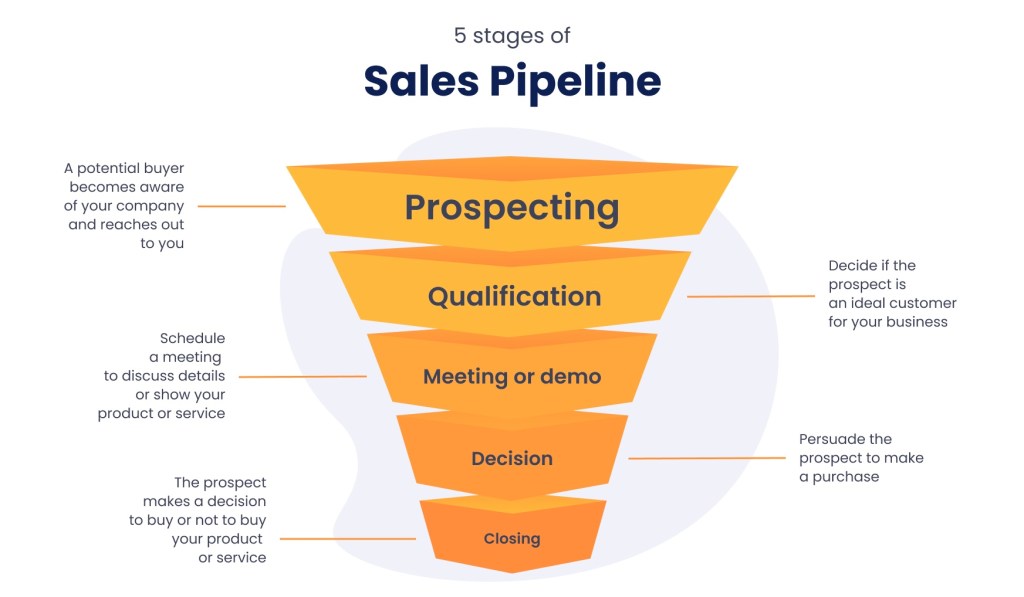
A sales pipeline is an organized, visual way of tracking potential buyers as they progress through different stages in the purchasing process and buyer’s journey.
A sales pipeline is the stages of a buyer’s journey from being interested to buying.
Value chain
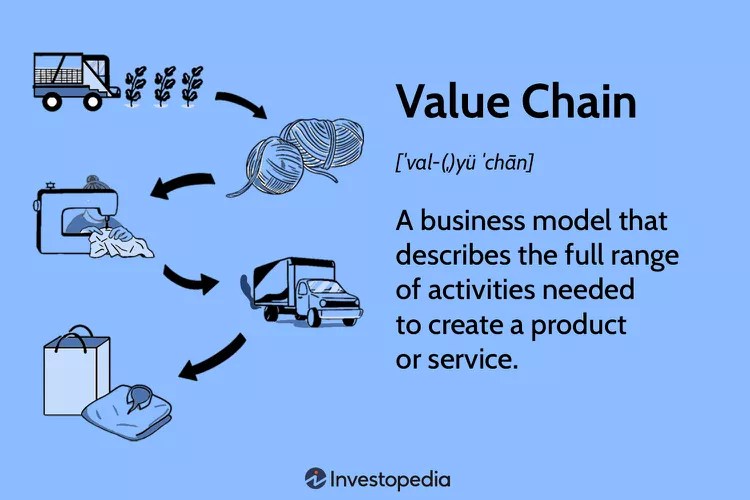
Value chain refers to the value your company brings to the market. Value can be measured in many ways, but generally, companies try to be either cost-effective (extremely low cost) or benefit-effective (extremely high benefit). The more value a company offers, the higher its chances of success. A value chain is a series of consecutive steps that go into the creation of a finished product, from its initial design to its arrival at a customer’s door. A value chain is a step-by-step business model for transforming a product or service from idea to reality. It’s a step by step model of a product from idea to reality.
Sales strategy sales terms
Always be closing (ABC )
ABC stands for “always be closing.” It’s a sales strategy that reminds reps that every step they take in the sales process is one step closer to closing the deal. Though it’s not a universally accepted strategy (different customers react differently to tactics and every rep needs to adjust accordingly), it is a nice reminder of the end game when things feel frustrating. every interaction between the seller and the customer pushes the customer further down the sales pipeline until they buy the product or service. It’s a strategy that reminds a seller that he must do is very best to finalize a sale or push a client toward a sale.
Account-based selling (ABS)
Account-based selling is a sales strategy where the entire company focuses on converting a few high-value leads rather than casting a broad net. This isn’t a long-term strategy, but it can be extremely useful if a company wants to use a high-profile client as a marketing pull for lower-profile customers. It is a strategy for sales teams to focus on and win business from specific high-value accounts. Account-based selling generally starts with identifying and targeting a specific list of accounts that the sales team believes they can win. Account-based selling treats each target company as a unique market.
BANT framework
The BANT framework is a checklist used during lead qualification.
B = Budget: Can the lead afford the product?
A = Authority: Is the lead a decision-maker with the authority to buy the product?
N = Need: Does the lead or their business need the product?
T = Time: Is this lead likely to purchase the product in the next sales cycle?
Leads that check all four boxes are extremely qualified and should be nurtured. It helps you rank and identify leads worth pursuing. 4 factors : budget, Authority, Need, Time.
Benefits
Benefits refer to how a product solves a prospect’s problems. Benefits should not be confused with features; benefits are the positive outcomes of features. For instance, time saved is a benefit, while automation is the feature that causes that benefit. When selling, reps highlight benefits, then describe how the product results in those benefits down the line.
What are the advantages of buying this product like saving time, free pillows that comes with bed.
Cold calling
Cold calling is the process of making an unsolicited phone call to a qualified lead in the hopes of turning them into a prospect. Cold calling is universally acknowledged as a difficult strategy, but it can produce results. It’s also a fast and personal way to contact numerous leads in a short amount of time. Making calls to get people to buy your products.
Cross-selling
Cross-selling is the act of selling an additional product or service to a customer. It occurs when a sales rep discovers that a prospect or client can benefit from more than one solution. For example, a rep for a mattress company can persuade a prospect to buy new pillows with their new mattress. In this case, the rep can potentially increase the value of the sale by directing the prospect to a different product within the same company.
Direct sales
Direct sales are sales that don’t require a middleman. The products are sold directly to the consumer from the seller. Direct sales has become synonymous with multi-level marketing, but they’re not the same. Multi-level marketing is direct sales through distributors who work as independent contractors for a larger company. Direct sales include selling a brand directly to a consumer , like Nike sell you shoes inside their store or a sales person come to your house to sell you a set of jewelry.
Discovery call
A discovery call is an initial conversation a lead (soon-to-be prospect) has with a sales rep. This can be a cold call or a scheduled call based on an information request. The discovery call is crucial in determining the prospect’s pain points and setting a positive tone for the relationship. A discovery call is the first interaction with a prospect interested in a specific product or service.
Feature
A feature is an aspect of a product that directly benefits a customer. For instance, mass email automation is a key feature of most marketing and sales software that helps the customer by simplifying large-scale marketing campaigns and saving time on outreach. A feature is an essential function or component of a good or service .It’s important to remember that the feature is not the benefit—it simply causes the benefit. For example, a feature of an oven is that it can fully heat up in five minutes. The benefit of this feature is that it allows you to cook a meal quickly.
Hard sell
A hard sell is an aggressive sales tactic in which the rep directly challenges the prospect’s objections. This is largely an outdated selling style, but in certain circles, it still pulls in large amounts of revenue. However, most companies now prefer a softer approach. A hard sell is a sales strategy that is direct and pushy, with the objective of getting the customer to get the product in the short-term.
Markup
A markup refers to a price increase for a product or service. It is the difference between the selling price of a good or service and its cost. You increase the price of a product to get more money due to the fact you needed more money that day. It’s usually done to compensate for expensive production costs or dips in revenue and profit. Mark-ups can be risky because they can deter current customers, but they can also save a struggling company from a bad month or quarter. For example, if a product sells for $125 and costs $100, the additional price increase is ($125 – $100) / $100) x 100 = 25%.
Markup calculates profit as a percentage of the cost price, while margin calculates profit as a percentage of the selling price.
- Gross Profit Margin = Sales Price – Unit Cost = $6.50 – $5.00 = $1.50.
- Markup Percentage = Gross Profit Margin/Unit Cost = $1.50/$5.00 = 30%.
- Gross Profit Margin Percentage = Gross Profit/Sales Price = $1.50/$6.50 = 23%
- Sales Price = Cost X Markup Percentage + Cost = $5.00 X 30% + $5.00 = $6.50
Objection
Objections are any concerns raised by prospects during a sales conversation. It is a reason why the buyer don’t want to buy a product like if it’s too big or expensive. Common objections are about the price of a product or the necessity of a product. Many reps use sales scripts to address these objections while still acknowledging the concerns. Example: I see the value in your product, but I’m not sure about buying it for X reason. There are 4 objections : need, urgency, trust and money.
Pain point
A pain point is a specific problem for a lead—a problem that can hopefully be fixed by a product or service from your company. Being able to understand and identify customer pain points is a key sales skill for reps. If a customer’s biggest need is ecommerce software and you’re trying to sell them customer service software, you’re unlikely to make the sale. Pain points are unmet needs waiting to be satisfied. A business owner has no computer and feels outdated, so you offer him to buy a brand new computer from you and fix his problem. Common pain points be : “ No one knows our company, our competition is outspending us, the market is leaving us behind, we not selling enough to keep the lights on, our staff is too old. 3 types of pain point : Positioning, financial, people.
Positioning statement
A positioning statement is a semi-prepared statement used by sales reps to start conversations with potential customers. A strong positioning statement lets the customer know who the sales rep is, who they work for, and what solutions they offer. Example : We’re Wistia. We make marketing software, video series, and educational content based on the belief that anyone can use video to grow their business and their brand.” A positioning statement is a description of your product and target audience and explains how it fills a market need.
Prospecting
Sales prospecting is the never-ending process of identifying and contacting potential buyers. Many companies have departments dedicated to this task because a strong sales pipeline requires constant movement and new leads. Prospecting tools can greatly help with this process.
Sales enablement
Sales enablement describes the process of providing your sales team with the tools, training, skills, or resources they need to succeed. This includes everything from sales software and mobile access to social media sales training and individual sales coaching.
Sales script
Sales scripts are written dialogues or guidelines used by sales reps while they’re interacting with prospects. These scripts can be extremely detailed and word-for-word, or they can simply be key points for a sales rep to touch on. Sales scripts help keep company branding and sales strategy consistent. Sales Script are script to use when selling a product to a prospect. Start with a brief introduction, confirm the prospect’s availability, explain company benefits, address pain points, handle objections, and conclude with a clear call to action
Smarketing
Smarketing is a newer term referring to the alignment of the sales and marketing departments for smoother workflows and consistent branding. The alignment of sales and marketing teams of a company through constant communication. In brief, it’s making sure the sales and marketing team are always talking to each other.
Social selling
Social selling is a sales strategy in which reps and companies use social media as a way to interact with prospects and existing customers. With social selling, social media is typically not where sales take place, but rather a means of communication and lead nurturing. The use of social media to sell things even if you don’t sell the actual product online.
Soft sell
A soft sell is a strategy in which sales reps take time to build trust with the prospect and work with them to find the ideal solution. Soft sales are extremely popular in the consumer market right now and are used by many sales reps.
Sound bite
Sound bites are small phrases that sales reps use to communicate simple matters to prospects. Usually, sound bites are answers to commonly asked questions or objections that make the rep’s life easier.
They are brief and clear statements that help pass the message to customers or answer a question they have. Sound bite of Mc Donald’s : Where’s the beef?
Upselling
Upselling is a tactic in which a rep tries to increase the value of a sale by encouraging a prospect to buy a higher-end version of the initial product they were interested in. Depending on the type of company, upsells may include additional features, more expensive products, or subscription upgrades. Upselling is a sales technique where a seller invites the customer to purchase more expensive items, upgrades, or other add-ons to generate more revenue.
Value proposition
A value proposition is a breakdown of all the benefits provided by a product, often in a concise statement. Sales reps may choose to emphasize or omit certain benefits from this list depending on the prospect. Apple’s value proposition is to provide premium, high-quality, innovative and user-friendly technology products and services that enrich the lives of its customers. 3 main elements of a value proposition: the headline, the subheadline, and a visual element.
Saas (Software as a service)
Software as a service (or SaaS) is a way of delivering applications over the Internet—as a service. Example : Microsoft, Shopify, Adobe, Mailshimp, Dropbox.
 More Knowing