an instance of a wrong or misinterpreted perception of a sensory experience.
Etymology : From Old French illusion, from Latin illūsiō, from illūdere, from in- (“at, upon”) + lūdere (“to play, mock, trick”).
misleading image presented to the vision : optical illusion. (2) : something that deceives or misleads intellectually. b(1) : perception of something objectively existing in such a way as to cause misinterpretation of its actual nature.
For example, hearing voices regardless of the environment would be a hallucination, whereas hearing voices in the sound of running water (or another auditory source) would be an illusion.
The psychological concept of illusion is defined as a process involving an interaction of logical and empirical considerations. Common usage suggests that an illusion is a discrepancy between one’s awareness and some stimulus
Illusion — an instance of a wrong or misinterpreted perception of sensory experience. Reality — the state of things as they exist, as opposed to an idealistic or notional idea of them.
Why illusions happen ?
Your senses gather information and send it to your brain. But your brain does not simply receive this information—it creates your perception of the world. This means that sometimes your brain fills in gaps when there is incomplete information, or creates an image that isn’t even there!
According to that, there are three main classes: physical, physiological, and cognitive illusions, and in each class there are four kinds: Ambiguities, distortions, paradoxes, and fictions.
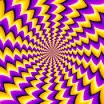
Also known as visual percepts, optical illusions refer to how your brain wrongly interprets what you see.
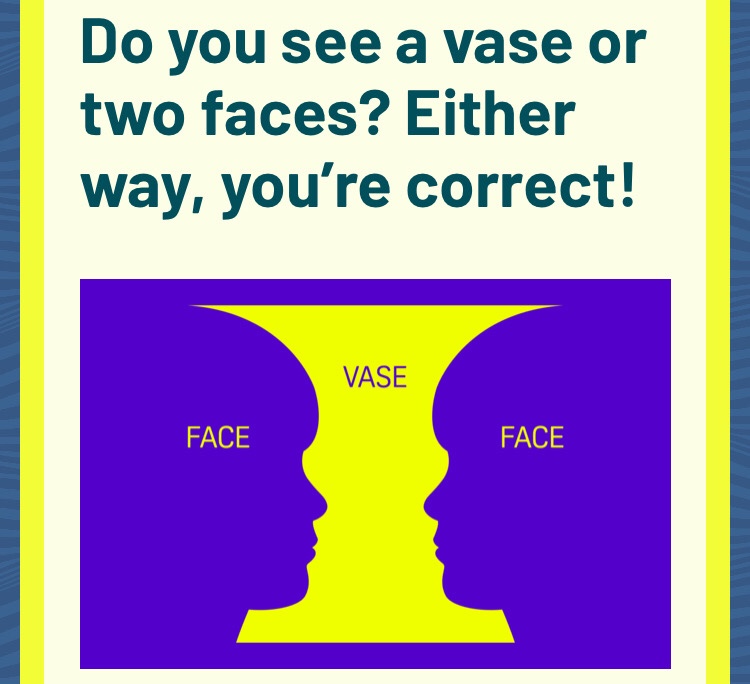
You might be able to see the vase and the faces. But you probably can’t see both at the same time
Your brain has to make a decision about which part of the picture is the object and which part is the background. Maybe you see the faces. That means your brain is interpreting the rest of the picture not as a vase but as the background. Maybe you see the vase instead. In that case, your brain is interpreting the rest of the picture not as faces but as the background.
Why does this happen? Evolution! Survival depends on fast reactions. Your brain has evolved to work quickly to piece together whatever bits and fragments it can get—and to do its best to figure out the rest.
 More Knowing